
This is a complete guide to the forbidden prayer times in the Shafi‘i school. You will learn the five prohibited times, how to check when they fall in your local prayer timetable, and which prayers are still allowed during them.
Forbidden Prayer Times at a Glance
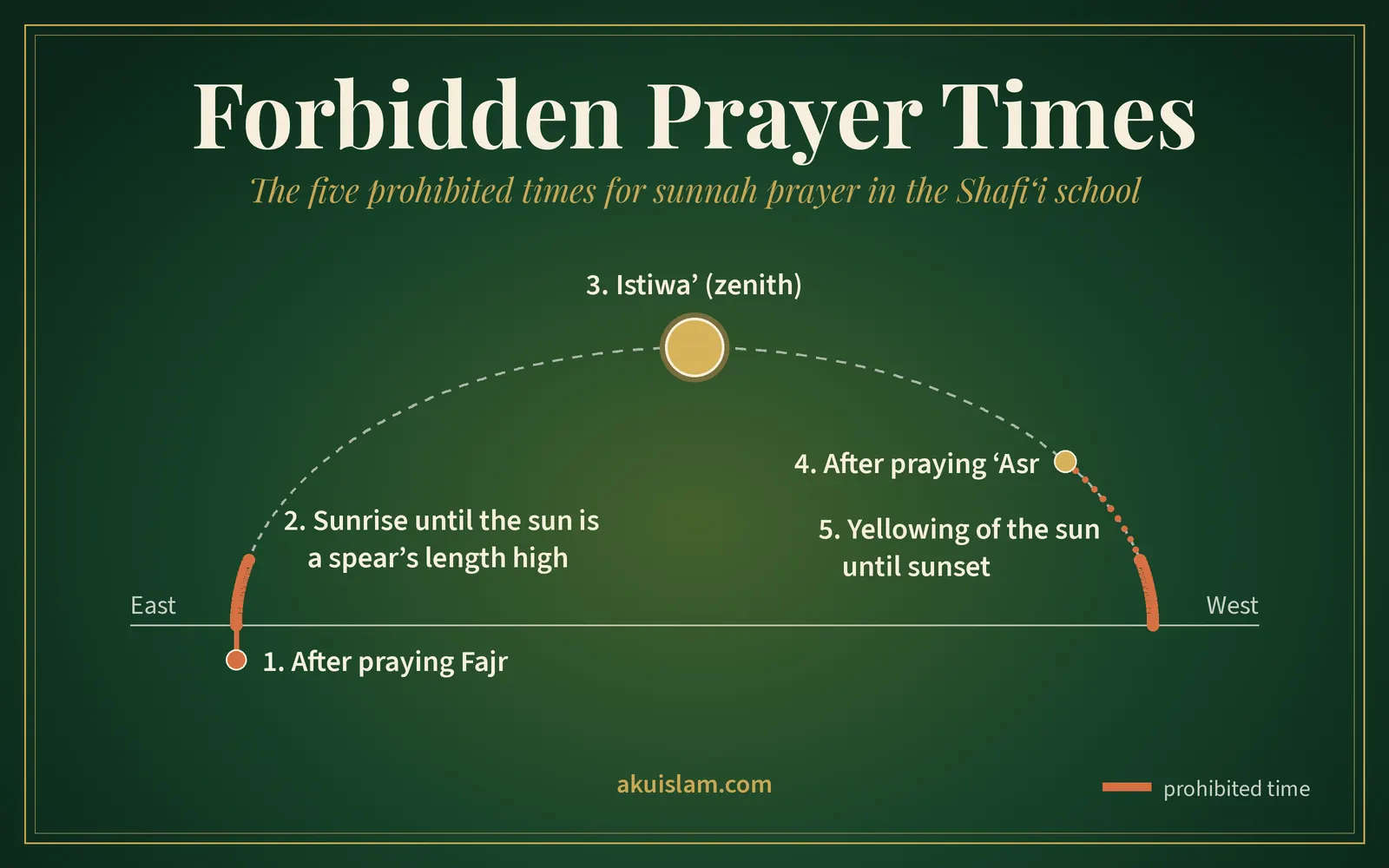
The forbidden prayer times are five times when it is prohibited to perform a sunnah prayer that has no cause.
- The five times: after praying Fajr until sunrise, from sunrise until the sun has risen a spear’s length, at istiwa’ (zenith), after praying ‘Asr until the sun turns yellow, and from the yellowing until sunset.
- Ruling: unlawful (haram), and the prayer is invalid.
- Not included: an obligatory prayer in its own time, making up missed prayers, and prayers that have a cause, such as the funeral prayer, tahiyyat al-masjid and the sunnah of wudu.
- Exceptions: istiwa’ on Friday, and prayer within the Haram of Makkah.
Contents
- The Five Forbidden Times for Sunnah Prayer
- What Does “Prohibited Time” (Waqt al-Tahrim) Mean?
- Evidence and Wisdom of the Prohibition
- What Time Are the Forbidden Prayer Times?
- Prayers That Are Still Allowed
- Tawbah, Hajat, Dhuha and Other Sunnah Prayers
- Exceptions: Friday and the Haram of Makkah
- Forbidden Prayer Times FAQ
- Closing: Five Short Windows, the Rest Wide Open
The Five Forbidden Times for Sunnah Prayer
When sunnah prayer is prohibited, and when the prohibition ends.
In the Shafi‘i school, a sunnah prayer that has no cause is prohibited at five times.1 Two of them are tied to an act, namely after you have prayed Fajr and after you have prayed ‘Asr. The other three are tied to time, namely at sunrise, at istiwa’ and when the sun turns yellow.2
| Prohibited time | Begins | Ends | Type |
|---|---|---|---|
| 1. After Fajr | After you have prayed Fajr | Sunrise (Shuruq) | Act3 |
| 2. At sunrise | Shuruq | The sun has risen a spear’s length, the start of Dhuha | Time |
| 3. At istiwa’ (zawal) | The sun stands directly overhead | The sun passes the meridian, when Zuhr begins | Time4 |
| 4. After ‘Asr | After you have prayed ‘Asr | The sun turns yellow | Act5 |
| 5. When the sun turns yellow | Sunlight begins to turn yellow | Sunset (Maghrib) | Time |
“After Fajr” Means After You Have Prayed It
The first and fourth prohibitions begin after you yourself have prayed that obligatory prayer, not as soon as its time comes in.
- Have not prayed Fajr yet? You may still pray sunnah prayers, for example the two rak‘ahs before Fajr, until you pray the obligatory Fajr. However, the prohibition at sunrise still applies, whether you have prayed Fajr or not.
- Have not prayed ‘Asr yet? You may still pray sunnah prayers until the sun turns yellow.
- Combined ‘Asr in advance in the time of Zuhr (jam‘ taqdim)? The prohibition after ‘Asr begins as soon as you finish that ‘Asr prayer, even though it is still the time of Zuhr.
What “a Spear’s Length” Means
Scholars describe a spear’s length as about seven cubits to the eye. It is an estimate of the sun’s height above the horizon, not an actual distance. In Malaysian prayer timetables, this moment is marked as the start of Dhuha.6
What Does “Prohibited Time” (Waqt al-Tahrim) Mean?
Two meanings that are often confused.
Waqt al-tahrim means a prohibited time. The term is used in two different chapters of fiqh, so make sure you know which meaning is intended.
| Term | Meaning | Who is affected |
|---|---|---|
| Prohibited time for sunnah prayer (the topic of this guide) | Five times when it is prohibited to perform a sunnah prayer that has no cause | Anyone who wants to pray a sunnah prayer. An obligatory prayer in its own time is not affected. |
| Prohibited time (hurmah) for obligatory prayer | The end of an obligatory prayer’s time, when there is no longer enough time to complete the prayer. What is unlawful is delaying the prayer until that moment.7 | Someone who deliberately delays an obligatory prayer |
Some books call these prohibited times “makruh times”. This means makruh tahrim, that is, disliked to the degree of being unlawful. Whoever performs a sunnah prayer that has no cause at these times is sinful, and the prayer is invalid.8
Evidence and Wisdom of the Prohibition
The hadiths on which this prohibition is based.
‘Uqbah ibn ‘Amir RA said: “There were three times at which the Messenger of Allah ﷺ forbade us to pray or to bury our dead: when the sun rises until it is up, when it is exactly midday until the sun passes the meridian, and when the sun begins to set until it has set.”9
‘Umar RA narrated that the Prophet ﷺ forbade prayer after Fajr until the sun has risen, and after ‘Asr until the sun has set.10
As for the wisdom behind it, the Prophet ﷺ explained to ‘Amr ibn ‘Abasah RA that the sun rises and sets between the two horns of Shaytan, and at that time the disbelievers prostrate to it.11 Some scholars, such as Ibn ‘Abd al-Salam, held that this prohibition is ta‘abbudi, that is, obeyed even though its wisdom is not fully known.12
What Time Are the Forbidden Prayer Times?
How to check them in your local prayer timetable.
The prohibited times change every day and differ from one zone to another. So do not rely on fixed clock times. Use your official local prayer timetable as follows.
| Prohibited time | Check in the timetable | Guidance |
|---|---|---|
| After Fajr until sunrise | Fajr and Shuruq (sunrise) | From after you pray Fajr until Shuruq |
| Sunrise until a spear’s length | Shuruq and the start of Dhuha | Wait for the start of Dhuha. It is roughly 15 to 25 minutes after Shuruq, depending on your timetable. |
| Istiwa’ (zawal) | Zuhr | A very short moment before Zuhr begins. Avoid starting a sunnah prayer in the last few minutes before the Zuhr adhan. |
| After ‘Asr until the sun turns yellow | ‘Asr | From after you pray ‘Asr |
| Yellowing until sunset | Maghrib | Timetables do not list the time of yellowing. If you have not yet prayed ‘Asr, avoid sunnah prayers once the sunlight has turned yellow before Maghrib. |
Is It Forbidden to Pray 15 to 30 Minutes Before Zuhr (Zawal Time)?
No. Istiwa’ is very short, barely noticeable before the sun passes the meridian.4 An astronomical study by the Selangor State Mufti Department estimates it at only about one to two minutes before Zuhr begins.13
So you do not need to hold back for half an hour before Zuhr. It is enough to avoid the last few minutes before the Zuhr adhan, because an opening takbir that falls within istiwa’ makes the prayer invalid. What many people call “zawal time” is this short moment of istiwa’. Zawal itself is the moment the sun passes the meridian, when Zuhr begins and the prohibition ends.
Example: Reading the Timetable
An example only. Suppose today’s timetable reads: Fajr 5.50 am, Shuruq 7.05 am, Zuhr 1.15 pm, ‘Asr 4.38 pm and Maghrib 7.22 pm.
- After praying Fajr at 6.00 am: sunnah prayer is prohibited until the start of Dhuha, around 7.20 to 7.30 am depending on your timetable.
- Before Zuhr: avoid starting a sunnah prayer in the few minutes before 1.15 pm.
- After praying ‘Asr at 4.45 pm: sunnah prayer is prohibited until Maghrib comes in at 7.22 pm.
Full guide
Ishraq Prayer (Salat al-Ishraq)
When the morning prohibition ends, and how to pray Ishraq after it.
Prayers That Are Still Allowed
This prohibition does not cover every prayer.
The prohibition applies only to prayers that have no cause and prayers whose cause comes after them. Prayers whose cause comes before them or at the same time are still allowed, on condition that you do not deliberately wait for the prohibited time to perform them.14
| Prayer | At the prohibited time | Reason |
|---|---|---|
| An obligatory prayer in its own time, for example ‘Asr when the sun has turned yellow | Valid | That is the prayer’s own time, even though it should not be delayed. If you catch one rak‘ah before the time ends, the prayer counts as performed on time (ada’).15 |
| Making up a missed obligatory prayer | Allowed | Its cause came earlier, namely the missed prayer.16 |
| Making up a missed sunnah rawatib prayer | Allowed | The Prophet ﷺ once made up the missed sunnah after Zuhr after praying ‘Asr.17 |
| The funeral prayer, the eclipse prayer, the istisqa prayer, the two rak‘ahs of tawaf, the sunnah of wudu, and repeating a prayer with a congregation | Allowed | Its cause comes before it or at the same time. |
| Tahiyyat al-masjid | Allowed | Except if you enter the mosque solely to pray tahiyyat at that time.18 |
| The prostration of recitation and the prostration of thanks | Allowed | Except if the verse of prostration is recited solely in order to prostrate at that time. |
| A general sunnah prayer (nafl mutlaq) and salatul tasbih | Prohibited | It has no cause.19 |
| The istikharah prayer and the sunnah prayer of ihram | Prohibited | Its cause comes after it. |
Do Not Deliberately Delay a Prayer Until the Prohibited Time
If you deliberately delay a prayer, including a make-up prayer, solely to perform it at a prohibited time, that is unlawful. The same ruling applies to someone who enters the mosque solely to pray tahiyyat at that time.20
Tawbah, Hajat, Dhuha and Other Sunnah Prayers
Short answers for the prayers people ask about most.
| Prayer | At the prohibited time | Guidance |
|---|---|---|
| Dhuha prayer | No clash | Its time begins after the morning prohibition ends, when the sun has risen a spear’s length.21 Do not pray Dhuha right at Shuruq. |
| Ishraq prayer | No clash | Performed after the morning prohibition ends. |
| Tawbah prayer | Pray it outside the prohibited times | See the note below. |
| Salatul hajat | Pray it outside the prohibited times | See the note below. |
| Salatul tasbih | Prohibited | It has no cause. |
| Istikharah prayer | Prohibited | Its cause comes after it. |
| The sunnah prayer before Fajr | Allowed before the obligatory Fajr | The prohibition after Fajr begins after the obligatory Fajr has been prayed. |
| Tahajjud and witr | No clash | Their time is at night, before dawn breaks. |
A Note on the Tawbah and Hajat Prayers
The jurists of the Shafi‘i school list prayer at the time of repentance and at the time of need as sunnah prayers.22 However, the reference books we checked do not explain whether the cause of these two prayers counts as preceding, which is allowed, or following, which is prohibited. So the safest course is to perform them outside the five prohibited times. Dua and istighfar are not bound by this prohibition.
Exceptions: Friday and the Haram of Makkah
Two situations not bound by the prohibition.
Istiwa’ on Friday
The prohibition at istiwa’ does not apply on Friday, even for someone who does not attend the Friday prayer.23 The prohibitions after Fajr and after ‘Asr still apply on Friday.
The Haram of Makkah
Sunnah prayer is allowed at any time within the Haram of Makkah, including Masjid al-Haram and the sacred precinct around it. The evidence is the saying of the Prophet ﷺ: “O Banu ‘Abd Manaf, do not prevent anyone from circling this House and praying at any hour he wishes, by night or by day.”24
This exception is specific to the Haram of Makkah. Some scholars, such as al-Mahamili, held that it is better not to do so, in order to avoid the disagreement of the scholars who prohibit it.
Forbidden Prayer Times FAQ
Short answers to common questions.
Here are answers to the most common questions about the forbidden prayer times.
After praying Fajr until sunrise, from sunrise until the sun has risen a spear’s length, at istiwa’, after praying ‘Asr until the sun turns yellow, and from the yellowing until sunset.2
Waqt al-tahrim means a prohibited time. In the chapter on sunnah prayer, it refers to the five prohibited times above. In the chapter on the times of obligatory prayer, it also means the end of a prayer’s time, when there is no longer enough time to complete the prayer.7
Before you pray the obligatory Fajr, yes. After praying it, a sunnah prayer that has no cause is prohibited until the sun has risen a spear’s length, that is, the start of Dhuha. Prayers with a preceding cause, such as a make-up prayer and the sunnah of wudu, are still allowed.3
Istiwa’ is a very short moment before Zuhr begins, about one to two minutes according to astronomical study. It is not 15 to 30 minutes. Avoid starting a sunnah prayer in the last few minutes before the Zuhr adhan.13
Yes. A make-up obligatory prayer has a preceding cause, so it is allowed, including after Fajr and after ‘Asr. Just do not deliberately delay it solely to perform it at a prohibited time.16,20
Yes. Pray straight away without waiting for the prohibited time to end, because the prayer is a make-up prayer with a preceding cause. If you catch one rak‘ah before sunrise, the prayer counts as performed on time.14,15
The safest course is to perform it outside the prohibited times, for example after Maghrib or at Dhuha time. Dua and istighfar may be done at any time.
No. The time between Shuruq and the sun rising a spear’s length is a prohibited time. Dhuha begins after that, so check the start of Dhuha in your local timetable.21
As soon as you finish that ‘Asr prayer, even though it is still the time of Zuhr. The prohibition after ‘Asr is tied to the act of praying ‘Asr.5
A sunnah prayer that has no cause is invalid if performed at a prohibited time, so it does not count. If you did not know about this prohibition before, stop once you know, and perform the prayer after the prohibited time ends.2
No. An obligatory prayer in its own time remains valid, for example ‘Asr prayed when the sun has turned yellow. If you catch one rak‘ah before sunset, that ‘Asr counts as performed on time. However, do not deliberately delay an obligatory prayer to the end of its time.15
Yes. A missed sunnah prayer also counts as a make-up prayer with a preceding cause. The Prophet ﷺ once prayed the two rak‘ahs of sunnah after Zuhr that he had missed, after praying ‘Asr.14,17
Yes. The prohibition at istiwa’ is lifted on Friday, even for someone who does not attend the Friday prayer.23
Closing: Five Short Windows, the Rest Wide Open
These five prohibited times are short compared with the whole day. Outside them, the door to sunnah prayer is wide open, by day and by night.
To choose which sunnah prayer to perform, how many rak‘ahs and when, see the guides under Keep Learning below.
May this be of benefit.
Footnotes & References
- Prayer is prohibited at istiwa’ except on Friday, after Fajr until the sun has risen a spear’s length, and after ‘Asr until sunset, except for prayers that have a cause and prayer within the Haram of Makkah. [Minhaj al-Talibin 1/22: «وتكره الصلاة عند الاستواء إلا يوم الجمعة وبعد الصبح حتى ترتفع الشمس كرمح والعصر حتى تغرب إلا لسبب كفائته وكسوف وتحية وسجدة شكر وإلا في حرم مكة على الصحيح»] ↩︎
- This prohibition is tied to an act at two times and to time at three times. Its ruling is unlawful (haram), and the prayer is invalid. [Tuhfat al-Muhtaj 1/440-441: «فالكراهة تتعلق بالفعل في وقتين وبالزمن في ثلاثة أوقات كما تقرر وهي للتحريم» … «وعليهما لا تنعقد»] ↩︎
- The prohibition after Fajr begins after Fajr has been prayed. Before that, sunnah prayer is allowed. From sunrise, the prohibition continues until the sun has risen a spear’s length, about seven cubits to the eye, whether or not you have prayed Fajr. [Tuhfat al-Muhtaj 1/440-441: «(وبعد) أداء فعل (الصبح حتى) تطلع الشمس بخلافه قبل فعلها يجوز النفل مطلقا ومن طلوعها حتى (ترتفع الشمس كرمح) طوله نحو سبعة أذرع في رأي العين» … «سواء أصلى الصبح أم لا»] ↩︎
- Istiwa’ is very short and barely noticeable before the sun passes the meridian, but an opening takbir can fall within it, making the prayer invalid. [Nihayat al-Muhtaj 1/384: «واعلم أن وقت الاستواء لطيف لا يتسع لصلاة ولا يكاد يشعر به حتى تزول الشمس إلا أن التحرم قد يمكن إيقاعه فيه فلا تصح الصلاة»] ↩︎
- The prohibition after ‘Asr begins after ‘Asr has been prayed, including ‘Asr combined in advance in the time of Zuhr, until the sun turns yellow. From the yellowing until sunset, the prohibition is tied to time. [Tuhfat al-Muhtaj 1/440-441: «(و) بعد أداء فعل (العصر) ولو لمن جمع تقديما (حتى) تصفر الشمس بخلافه قبل فعلها يجوز النفل مطلقا ومن الاصفرار حتى (تغرب)»] [Nihayat al-Muhtaj 1/384: «(وبعد صلاة العصر) أداء ولو مجموعة في وقت الظهر»] ↩︎
- Examples of estimates in official timetables: “Awal Waktu Dhuha: 25 minit selepas waktu Syuruk” (start of Dhuha: 25 minutes after sunrise) in the 2024 Prayer Timetable for the Federal Territories of Kuala Lumpur and Putrajaya (source: JAKIM’s Almanak Falak Syarie) [Link], and “Waktu Dhuha bermula kira-kira 15 minit selepas Waktu Syuruk” (Dhuha begins about 15 minutes after sunrise) in the 2026 Prayer Timetable of the State of Perak, Perak State Mufti Department [Link]. ↩︎
- In the chapter on the times of obligatory prayer, the prohibited time is the end of the time, when there is not enough left to complete the prayer. What is unlawful is delaying the prayer until that moment. [Tuhfat al-Muhtaj 1/418: «ولها وقت فضيلة أول الوقت، وجواز إلى ما يسع كله، ثم حرمة ونوزع فيه بأن المحرم التأخير إليه لا إيقاعها فيه»] ↩︎
- Whoever performs a prohibited prayer at these times is sinful, and the prayer is invalid. [Nihayat al-Muhtaj 1/386: «ومن فعل صلاة حكم بكراهتها في الأوقات المتقدمة أثم ولم تنعقد»] The word “makruh” in the Minhaj means makruh tahrim. [Nihayat al-Muhtaj 1/384: «(وتكره الصلاة) كراهة تحريم»] ↩︎
- Hadith of ‘Uqbah ibn ‘Amir RA. [Sahih Muslim 831] «ثلاث ساعات كان رسول الله صلى الله عليه وسلم ينهانا أن نصلي فيهن، أو أن نقبر فيهن موتانا: «حين تطلع الشمس بازغة حتى ترتفع، وحين يقوم قائم الظهيرة حتى تميل الشمس، وحين تضيف الشمس للغروب حتى تغرب»». ↩︎
- Hadith of Ibn ‘Abbas RA from ‘Umar RA. [Sahih al-Bukhari 581] «أن النبي صلى الله عليه وسلم نهى عن الصلاة بعد الصبح حتى تشرق الشمس، وبعد العصر حتى تغرب». ↩︎
- Hadith of ‘Amr ibn ‘Abasah RA. [Sahih Muslim 832] «فإنها تطلع حين تطلع بين قرني شيطان، وحينئذ يسجد لها الكفار». ↩︎
- Ibn ‘Abd al-Salam held that this prohibition is purely ta‘abbudi, and that the wisdoms put forward are not clear. [Tuhfat al-Muhtaj 1/441: «وأطال ابن عبد السلام في الانتصار إلى أنه تعبد محض»] ↩︎
- Nabeela Akrasha Surtahman and Zubair Amir Nur Rashid, “Penentuan Waktu Rembang Menurut Hitungan Falak dan Hukum Solat Padanya” (Determining the Time of Zenith by Astronomical Calculation and the Ruling on Praying in It), Journal of Fatwa and Falak Selangor (JUFFAS), vol. 1, no. 1 (June 2024), pp. 86-104. The zenith period is estimated at about 1 minute 4 seconds if measured from the centre of the sun, and 2 minutes 8 seconds if measured from the solar disc, before Zuhr begins. [Link] ↩︎
- The prayers excepted are those that have a cause, on condition that the cause is not sought out deliberately, and that it comes before or at the same time as the prayer. This includes a make-up prayer, even a make-up sunnah prayer. [Tuhfat al-Muhtaj 1/441: «(إلا لسبب) لم يتحره متقدم على الفعل، أو مقارن له (كفائتة) ولو نافلة اتخذها وردا»] ↩︎
- If one rak‘ah falls within the time, the whole prayer counts as performed on time (ada’). If less, it counts as a make-up (qada’). [Minhaj al-Talibin 1/21: «ومن وقع بعض صلاته في الوقت فالأصح أنه إن وقع ركعة فالجميع أداء وإلا فقضاء»] Hadith of Abu Hurairah RA. [Sahih Muslim 608] «من أدرك ركعة من الصبح قبل أن تطلع الشمس، فقد أدرك الصبح، ومن أدرك ركعة من العصر قبل أن تغرب الشمس، فقد أدرك العصر». ↩︎
- Among the prayers with a cause that are allowed: the two rak‘ahs of tawaf, the funeral prayer, repeating a prayer with a congregation, the istisqa prayer and the sunnah of wudu. Ibn al-Mundhir reports consensus that missed prayers and the funeral prayer may be performed after Fajr and ‘Asr. [Tuhfat al-Muhtaj 1/442-443: «وركعتي طواف وصلاة جنازة ولو على غائب على الأوجه وإعادة مع جماعة» … «وصلاة استسقاء وسنة وضوء» … «وقد نقل ابن المنذر الإجماع على فعل الفائتة وصلاة الجنازة بعد الصبح، والعصر»] ↩︎
- Hadith of Umm Salamah RA. The Prophet ﷺ explained that the two rak‘ahs he prayed after ‘Asr were the two rak‘ahs after Zuhr that he had missed. [Sahih al-Bukhari 1233] «فشغلوني عن الركعتين اللتين بعد الظهر فهما هاتان». ↩︎
- Tahiyyat al-masjid is allowed if a person did not enter the mosque solely to pray tahiyyat. The prostration of thanks and the prostration of recitation are also allowed, except if the verse of prostration is recited solely in order to prostrate at that time. [Tuhfat al-Muhtaj 1/441-442: «(وتحية) لم يدخل المسجد بقصدها فقط (وسجدة شكر) وتلاوة» … «ومحله إن لم تقرأ قبل الوقت، أو فيه بقصد السجود فقط فيه وإلا لم تنعقد»] [Nihayat al-Muhtaj 1/386: «وتلاوة لم يقرأ آيتها ليسجد»] ↩︎
- A prayer that has no cause, such as salatul tasbih, and a prayer whose cause comes after it, such as istikharah and the sunnah of ihram, remain prohibited. [Tuhfat al-Muhtaj 1/443: «أما ما لا سبب لها كصلاة التسبيح وذات السبب المتأخر كركعتي الاستخارة وركعتي الإحرام»] ↩︎
- Deliberately delaying a prayer, including a make-up prayer, to perform it at a prohibited time is unlawful. The same ruling applies to someone who enters the mosque solely to pray tahiyyat at that time. [Tuhfat al-Muhtaj 1/443: «أما إذا تحرى إيقاع صلاة غير صاحبة الوقت في الوقت المكروه من حيث كونه مكروها» … «فيحرم مطلقا ولو فائتة يجب قضاؤها فورا» … «وكذا إذا دخل المسجد بقصد التحية فقط»] ↩︎
- The time of Dhuha begins when the sun has risen a spear’s length and lasts until the sun passes the meridian. [Tuhfat al-Muhtaj 2/232: «ووقتها من ارتفاع الشمس كرمح»] ↩︎
- Among the sunnah prayers mentioned: at a time of need and at a time of repentance. [Tuhfat al-Muhtaj 2/238: «وعند الحاجة وعند التوبة»] ↩︎
- The Friday exception applies even to someone who does not attend the Friday prayer. Its hadith has been criticised, but it is supported by other evidence. [Tuhfat al-Muhtaj 1/440-441: «(إلا يوم الجمعة) ولو لمن لم يحضرها لحديث فيه لكن فيه مقال إلا أن يكون قد اعتضد»] ↩︎
- This exception covers the whole Haram of Makkah, that is, the mosque and the other areas where hunting is prohibited. Al-Mahamili held that it is better not to do so, in order to avoid the disagreement of those who prohibit it. [Tuhfat al-Muhtaj 1/443-444: «(وإلا) صلاة (في) بقعة من بقاع (حرم مكة) المسجد وغيره مما حرم صيده (على الصحيح) للحديث الصحيح «يا بني عبد مناف لا تمنعوا أحدا طاف بهذا البيت وصلى أية ساعة شاء من ليل أو نهار»» … «قال المحاملي، والأولى عدم الفعل خروجا من خلاف من حرمه»] ↩︎
Further Reading
- al-Nawawi, Minhaj al-Talibin wa ‘Umdat al-Muftin.
- Ibn Hajar al-Haytami, Tuhfat al-Muhtaj bi Sharh al-Minhaj, volumes 1 and 2.
- Shams al-Din al-Ramli, Nihayat al-Muhtaj ila Sharh al-Minhaj, vol. 1.
- al-Bukhari, Sahih al-Bukhari. Muslim, Sahih Muslim.