

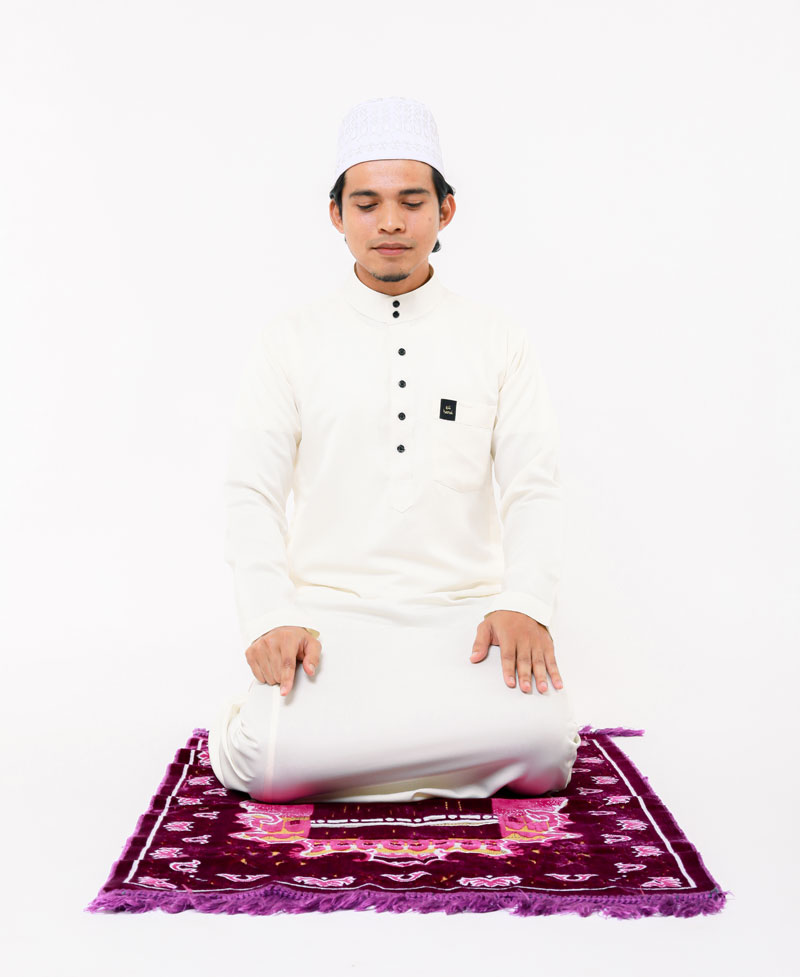
How to recite Attahiyat?
This article is a complete and straightforward guide for attahiyat full dua recitation.
The best part is:
It is simplified with English transliteration and assisted by audio to help you who are not proficient in reading Arabic writing.
The target readers of this guide are those who are just learning prayer, children, and converts.
If you think this guide is for you, let’s get started.
Introduction
The reading of the initial attahiyat and the final attahiyat are the pillars of prayer.
Therefore, recite this reading with proper makhraj and tajwid.
Pillars of prayer must be known and implemented in prayer.
Prayer is not valid when one of the pillars is missed.
Leaving one of the pillars of prayer intentionally, the prayer will be void.
If forgotten, prayer is not void. But it is necessary to add the missing pillar when remembering.
For example, a person who forgets to recite attahiyat while sitting in the final tasyahud, instead reciting al-Fatihah. When he realizes his mistake, he needs to continue reading attahiyat.
The Version of Attahiyat in This Guide
There are various versions of Attahiyat.
The version in this guide is the Shafi’e school uses a version attributed to Ibn Abbas.
This view of the Shafi’e School is held firmly by the Muslim community, especially in Southeast Asia, including Malaysia, Brunei, Singapore, and Indonesia.
Attahiyat Meaning
What is attahiyat means?
The Tashahud in Arabic (تَشَهُّد) brings the meaning of “testimony [of faith],” also known as attahiyat (ٱلتَّحِيَّات), the ‘greetings’.
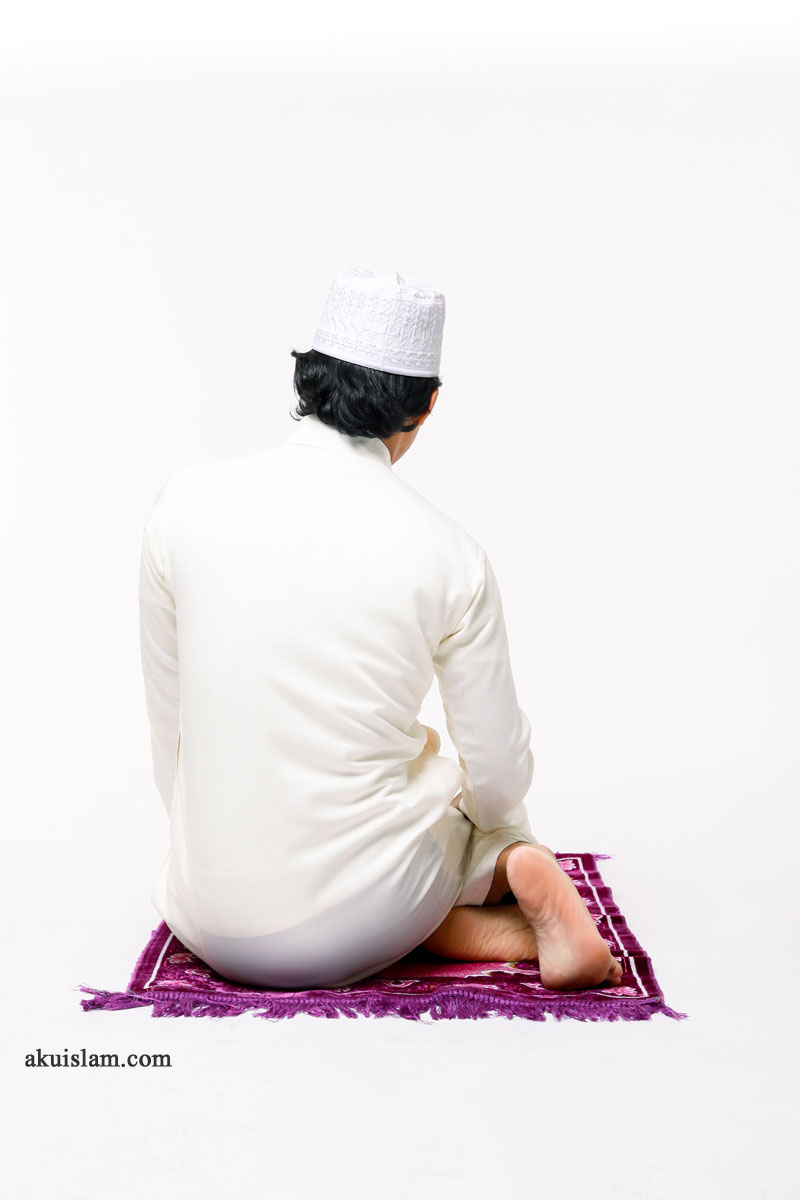
It is the part of the prayer where the person kneels or sits on the ground facing the qibla, glorifies God, greets the messenger, and the righteous people of God, followed by the two testimonials.
The recitation is followed by an invocation of the blessings and peace upon the Prophet known as Salawat.
Attahiyat Dua In First Tashahud
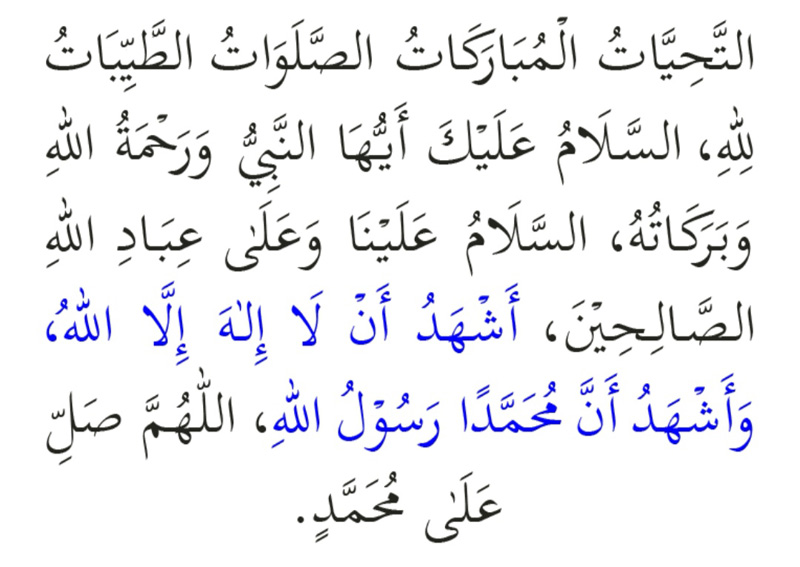
The recitation of attahiyat in the first tashahud as follows:
Note:
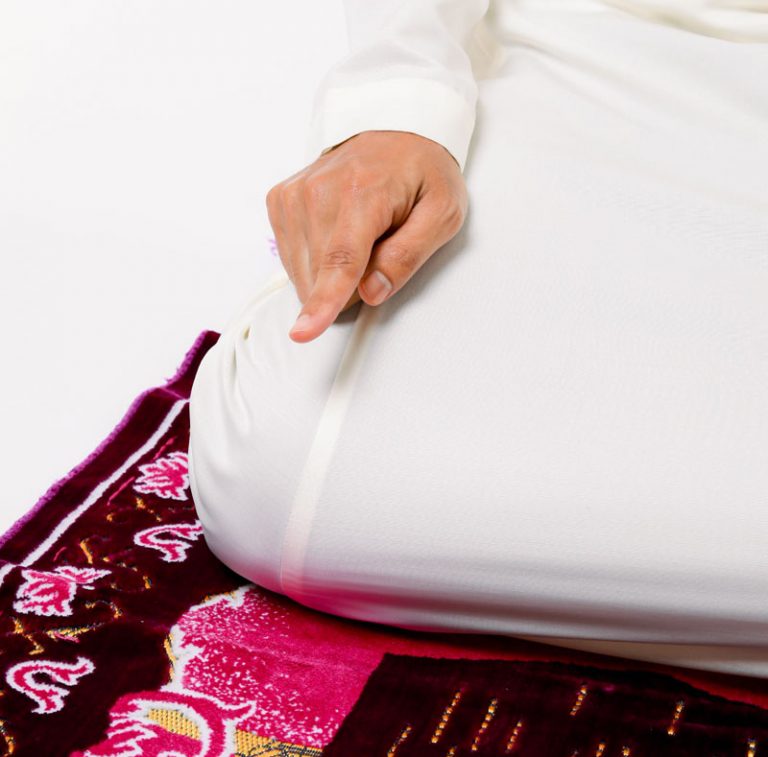
During the shahadah (written in blue), we must uphold the right index finger.
Transliteration
AtTahiyyatul MubaRakaaTush SolaWaaTuth ThayyiBaTu Lillaah,
AssaLaaMu’aLaika AyyuHan Nabiyyu WarahMatulLaahi WabaraKaaTuh,
Assalaamu’alaina wa’alaa ‘ibaadillaahish shoolihiin.
AsyHadu alLaa ilaaHa ilLalLaah,
WaAsyHadu Anna MuhamMadan RasuuLullaah.
AllahHumma Solli ‘Alaa Sayyidina Muhammad
Meaning:
Blessed salutations, prayers, good deeds to God. Peace be upon you, O Prophet, as well as God’s mercy and His blessings. Peace be upon us and upon the righteous servants of God. I bear witness that there is no deity but God, and I bear witness that Muhammad is His servant and His messenger.
Attahiyat Full Dua In Final (Second) Tashahud
What is the difference of attahiyat between first and final tashahud?
The difference of attahiyat recitation in the first and final tashahud is, in the second tashahud, we are adding Assalatul-Ibrahimiyah:
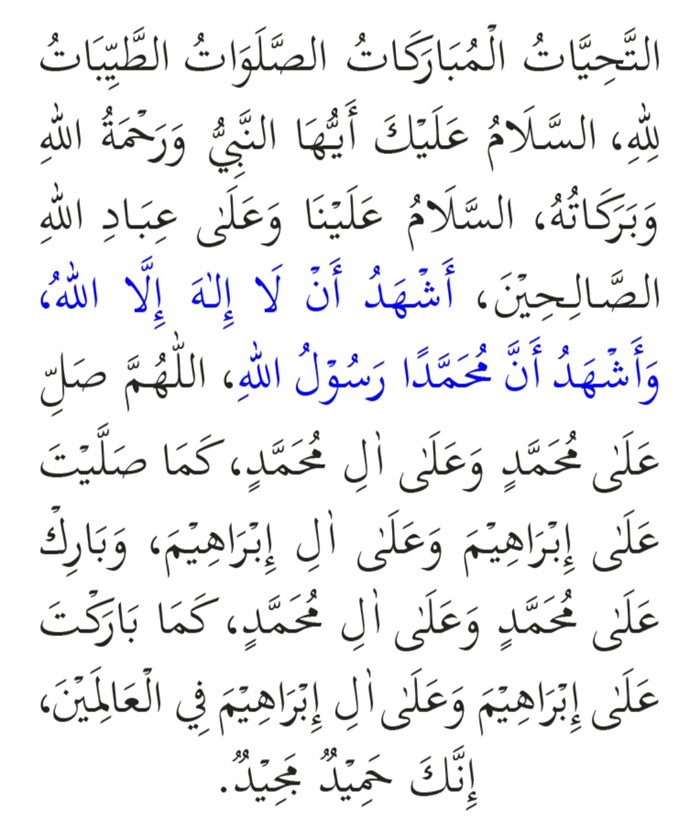
The recitation is as follows:
Note:
During the shahadah (written in blue), we must uphold the right index finger.
Transliteration
AtTaHiyaTul MubaRakaTush SolawaTuth ThayYiBaTu Lillah.
Assalamu’alaika AyyuHan NabiyYu WarahMatullaHi WaBaRaKaTuh.
Assalamu’Alayna Wa ’Alaa ‘ibaDilLaHis Solihin.
Asyahadu alLaa ilaHa ilLallah.
Wa ’AsyHadu Anna Muhammadar Rasulullah.
AllahumMa Solli ’Alaa Muhammad Wa ’Alaa Ali Muhammad.
Kama SollayTa ’Ala Ibrahim Wa ’Alaa Ali Ibrahim.
Wabarik ‘Alaa Muhammad Wa ’Alaa Ali Muhammad.
Kama BarakTa ‘Alaa Ibrahim Wa ’Alaa Ali Ibrahim Fil ‘AlaMin inNaka Hamidum-Majid.
Meaning:
Blessed salutations, prayers, good deeds to God. Peace be upon you, O Prophet, as well as God’s mercy and His blessings. Peace be upon us and upon the righteous servants of God. I bear witness that there is no deity but God, and I bear witness that Muhammad is His servant and His messenger.
O Allah, let Your mercy come upon Muhammad and the family of Muhammad as You let it come upon Ibrahim and the family of Ibrahim O Allah, bless Muhammad and the family of Muhammad as You blessed Ibrahim and the family of Ibrahim. Indeed You are Praiseworthy and Glorious.”
Hadith on The Tashahhud In The Prayer
Abdullah (b. Mas`ud) said:
While observing prayer behind the Messenger of Allah (ﷺ) we used to recite: Peace be upon Allah, peace be upon so and so. One day the Messenger of Allah (ﷺ) said to us: Verily Allah is Himself Peace. When any one of you sits during the prayer, he should say: All services rendered by words, by acts of worship, and all good things are due to Allah. Peace be upon you, O Prophet, and Allah’s mercy and blessings. Peace be upon us and upon Allah’s upright servants, for when he says this it reaches every upright servant in the heavens and the earth. (And say further): I testify that there is no god but Allah and I testify that Muhammad is His servant and Messenger. Then he may choose any supplication which pleases him and offer it.
— Sahih Muslim
Conditions of Tashahud (Attahiyat)
There are several things required in tashahud:
- Listening to himself reciting Tasyahud
- Sequential reading of the words tashahud. If it is interspersed with the recite of a foreign question or a long silence, then the tashahud is not counted.
- Recite tashahud in sitting, followed by greetings.
- Recite tashahud in Arabic.
- Keeping the makhraj’s recitation of tashahud letters.
- Keep reading the lines of sabdu in tashahud.
- Read tashahud in order. Reading tashahud in order is a condition that the reading will change its meaning if it is not read in order.
Legal Conditions of Salawat in Attahiyat
There are several conditions when saying Salawat in the recitation of Tahiyat.
- It should be read until he can hear – if his hearing is fair.
- Must use the words “Muhammad” or “Ar-Rasul” or “An-Nabi”. It is not enough or illegal to say Salawat if you only mention Ahmad.
- Read it in Arabic. If unable because of ignorance, he should read the translation in any language he knows. However, he was required to study it in Arabic.
- His speech should be in Arabic; if he cannot read in Arabic, he can recite his translation in any language, but he is obliged to learn it in Arabic.
- Maintaining makhraj (place of letters) and all syaddah (sabdu) when reading it. If the makhraj changes or does not care about the syaddah, or mispronounces the sentence so as to change the meaning, cancel the reading of tashahud and it is obligatory to repeat it.
- Read according to the order of the verses that have been taught by the Prophet.
Advantages of Attahiyat
What are the advantages of Tahiyat?
Tahiyat is when we offer our homage to the Ruler of heaven and earth who is glorified, adored, and praised.
There are four forms of honor presented in attahiyat:
- A special tribute to al-Khalid, our Creator with words beginning with اَلتَّحِيَّاتُ (all honors/congratulations)
- Respect for the Messenger of Allah with the words اَلسَّلَامُ عَلَيْكَ (peace be upon you)
- Respect and prosperity over ourselves with the words اَلسَّلَامُ عَلَيْنَا (peace be upon us)
- Respect and prosperity for all the pious servants of Allah with the words عِبَادِ اللّٰهِ الصَّالِحِينَ (pious servants)
Once we have pronounced respect and prosperity on all the pious servants of God, we strengthen our membership in a large group of pious creatures of God in this world by uttering shahadah.
This proves that the testimony that there is no God to be worshiped except Allah and Prophet Muhammad is the messenger of Allah is the same as their testimony.
Our faith is also the same as their faith in Allah and His messenger.
Conclusion
I hope this guide helps you.
If you need help or have any questions, you can leave the matter in the comments section below.
Related guides:

Assalamu’alaikum.
JazakAllahu khayran for remembering me in your du‘a. May Allah reward you, accept your prayers, and grant you steadfastness in worship.
Allah knows best.
Assalamu’alaikum.
Alhamdulillah, I’m glad this guide was beneficial. May Allah make your salah easier and accept all your prayers. If you need clarification on any part, feel free to ask here.
Wa’alaikumussalam.
Thank you for clarifying this with good manners. You’re right that different regions and madhhabs often adopt different authentic narrations of the tashahhud.
The important point is: the tashahhud has multiple sound wordings, and Muslims should avoid turning these differences into disputes.
May Allah accept from all of us.
Assalamu’alaikum.
Yes, what you quoted is a well-known and authentic wording of the tashahhud (commonly narrated from Ibn Mas‘ud).
In this guide, I used the wording that is commonly recited in the Shafi‘i tradition in Southeast Asia (often attributed to Ibn ‘Abbas). Scholars mention that the tashahhud has more than one authentic narration, so the differences in wording are not unusual.
The key is to recite an established tashahhud correctly and consistently (especially when praying in congregation, follow the imam).
May Allah accept our salah.
Assalamu’alaikum Layth.
In the Shafi‘i school, the final tashahhud (attahiyat akhir) is a pillar (rukun) of salah, so it can’t be replaced by reciting al-Fatihah or something else.
If you realize during the prayer (before salam): go back to the sitting position, recite the final tashahhud (and salawat), then continue and give salam.If you only realize after you already gave salam: the safer Shafi‘i ruling is to repeat the prayer, because a pillar was missed.
If this happens because you’re still learning and haven’t memorized it yet, take it step by step, learn the shorter part first and keep practicing.
Allah knows best.
Mashaalah this website helped me a lot Thank you very much.
Mashaalah this website helped me a lot Thank you very much.
Assalamu’alaikum.
Alhamdulillah, I’m glad this guide was beneficial. May Allah make your salah easier and accept all your prayers. If you need clarification on any part, feel free to ask here.
Thanks for this i will include you in my dua
Assalamu’alaikum.
JazakAllahu khayran for remembering me in your du‘a. May Allah reward you, accept your prayers, and grant you steadfastness in worship.
Allah knows best.
BAD ENOUGH
Shut up nigger
astaghfirullah
astugfullah please stop!
At start shouldn’t it be.
Assalmualaikum Brother,
The author of the blog had provided Tahiyat according to Mazhab Shafi’. If I am not mistaken, what you have mentioned is used by Mazhab Hanafi. By Allah’s grace, both are accepted and may Allah accepts our salah.
Wa’alaikumussalam.
Thank you for clarifying this with good manners. You’re right that different regions and madhhabs often adopt different authentic narrations of the tashahhud.
The important point is: the tashahhud has multiple sound wordings, and Muslims should avoid turning these differences into disputes.
May Allah accept from all of us.
Assalamu’alaikum.
Yes, what you quoted is a well-known and authentic wording of the tashahhud (commonly narrated from Ibn Mas‘ud).
In this guide, I used the wording that is commonly recited in the Shafi‘i tradition in Southeast Asia (often attributed to Ibn ‘Abbas). Scholars mention that the tashahhud has more than one authentic narration, so the differences in wording are not unusual.
The key is to recite an established tashahhud correctly and consistently (especially when praying in congregation, follow the imam).
May Allah accept our salah.
What if he doesn’t know instead of forgot? Can someone still recite al-fatihah to make it up?
Assalamu’alaikum Layth.
In the Shafi‘i school, the final tashahhud (attahiyat akhir) is a pillar (rukun) of salah, so it can’t be replaced by reciting al-Fatihah or something else.
If this happens because you’re still learning and haven’t memorized it yet, take it step by step, learn the shorter part first and keep practicing.
Allah knows best.
اَلسَّلَامُ عَلَيْكُمْ Thank you For The Attahiyat Downloaded Hope It’s ok nice Reciting Masha Allah
Alhamdulillah. I hope this guide helped