
This is a complete guide to the nafl prayer known as nafl mutlaq, the general voluntary prayer, from its meaning and wording of intention to how to pray its two rak‘ahs step by step.
The guide also answers the questions people often ask: how many rak‘ahs, when to pray it, and examples of suitable occasions, according to the Shafi‘i school. Every recitation comes with Arabic script, transliteration and meaning.
Nafl Mutlaq at a Glance
Nafl mutlaq is a sunnah prayer that is not tied to a particular time or cause.1
- Ruling: sunnah, and it may be prayed at any time except the prohibited times.2
- Number: no limit. The best is two rak‘ahs with one salam, repeated as you are able.3,4
- Niyyah: intending to perform a prayer is enough. Naming the prayer and the number of rak‘ahs is not obligatory.5
- Best time: the night, especially the middle of the night.
- Examples: while waiting for the Friday sermon, in the Rawdah, when facing a difficulty, or in your free time.
What Is the Nafl Mutlaq Prayer For?
The meaning, ruling and purpose of nafl mutlaq.
Nafl mutlaq is a sunnah prayer that is not tied to a particular time and does not depend on a particular cause. The word mutlaq means unrestricted, that is, not linked to anything.
It differs from the sunnah prayers that have a time, such as the rawatib and Dhuha, and the sunnah prayers that have a cause, such as tahiyyat al-masjid and the sunnah prayer after wudu. Those prayers must be named in the intention. Nafl mutlaq does not need to be.1
Ruling of Nafl Mutlaq
It is sunnah. It may be prayed at any time, day or night, except during the prohibited times for prayer.2
Why Pray Nafl Mutlaq?
Nafl mutlaq is the easiest way to add to your voluntary deeds. Among its purposes:
- To draw near to Allah. In a hadith qudsi, the servant who keeps adding voluntary deeds becomes loved by Allah.6
- They make up for shortcomings in the obligatory prayers on the Day of Reckoning.7
- A refuge when difficulties come. When something troubled the Prophet ﷺ, he would pray.8
- To make many prostrations. Every prostration raises you one degree and removes one sin.9
The Place of Nafl Mutlaq
Voluntary prayer is the best of voluntary deeds. However, in the order of merit among the sunnah prayers, nafl mutlaq comes last.10 So do not leave the rawatib and the sunnah prayers with a cause for the sake of nafl mutlaq. Fill your free time with it.
Examples of When to Pray Nafl Mutlaq
Common occasions that suit two extra rak‘ahs.
Because it is not tied to a time or cause, nafl mutlaq can be prayed on many occasions. Here are common examples:
| Situation | Notes |
|---|---|
| Waiting for the Friday sermon | Pray as much as you can before the khatib goes up the pulpit.11 |
| In the Rawdah, the Prophet’s Mosque | The space between the house and the pulpit of the Prophet ﷺ is one of the gardens of Paradise.12 |
| On entering a mosque | Two rak‘ahs of nafl mutlaq also earn the reward of tahiyyat al-masjid.13 |
| Facing a difficulty or worry | Follow the Prophet ﷺ, who prayed when something troubled him.8 |
| At night | Voluntary prayer at night is better, especially in the middle of the night.4 |
| Free time at home | Voluntary prayer is better prayed at home.14 |
Nafl Mutlaq on Friday
The Prophet ﷺ mentioned the person who takes a bath, comes to the Friday prayer, prays what was decreed for him, then listens in silence until the sermon ends. His sins between that Friday and the next are forgiven, plus three days.11
Friday is also exempt from the prohibition of praying when the sun is at its zenith (istiwa’).2 However, stop starting a new prayer once the khatib has gone up and sat on the pulpit. If you have just come in while the sermon is under way, pray two short rak‘ahs of tahiyyat al-masjid only.15
Nafl Mutlaq in the Rawdah
The Rawdah is the space between the house of the Prophet ﷺ and his pulpit in the Prophet’s Mosque in Madinah. The Prophet ﷺ called it one of the gardens of Paradise.12
Pilgrims who get the chance to enter the Rawdah usually pray two sunnah rak‘ahs and make dua. If it is not a particular prayer, that is nafl mutlaq, and it is prayed the same way as the guide below. Make sure it is not a prohibited time, and do not lengthen the prayer so much that it makes things difficult for others waiting their turn.
Niyyah for Nafl Prayer (Transliteration and Meaning)
The intention is made in the heart at the opening takbir.
For nafl mutlaq, intending to perform a prayer is enough. You are not obliged to state the name of the prayer, the word “sunnah” or the number of rak‘ahs.5 The wordings below only help the heart settle the intention. Choose either one.
Wording 1: Niyyah for Two Rak‘ahs
أُصَلِّي سُنَّةً رَكْعَتَيْنِ لِلّٰهِ تَعَالَى
Uṣallī sunnatan rak‘ataini lillāhi ta‘ālā.
Meaning
“I pray two rak‘ahs of a sunnah prayer for the sake of Allah, the Most High.”
Wording 2: Niyyah Without Stating the Number of Rak‘ahs
أُصَلِّي سُنَّةً لِلّٰهِ تَعَالَى
Uṣallī sunnatan lillāhi ta‘ālā.
Meaning
“I pray a sunnah prayer for the sake of Allah, the Most High.”
The first wording suits most people. If you intend without stating a number, you may give salam after two rak‘ahs, or add more.3 Making the intention in your own language is enough, as long as the heart holds it at the opening takbir.
How to Pray Nafl Mutlaq: 2 Rak‘ahs
Follow these 20 steps, from the opening takbir to the salam.
Before You Begin
- Make sure you have wudu, your awrah is covered and you are facing the qibla.
- Make sure it is not a prohibited time, such as after the Fajr prayer or after the Asr prayer. See the time of nafl mutlaq.
- Decide the number of rak‘ahs. This guide shows two rak‘ahs, which is the best way.
Rak‘ah 1 of 2
First Rak‘ah
Begin with the Intention and the Opening Takbir
Stand upright facing the qibla. Hold the intention of nafl mutlaq in your heart as you say the opening takbir.
أُصَلِّي سُنَّةً رَكْعَتَيْنِ لِلّٰهِ تَعَالَى
Uṣallī sunnatan rak‘ataini lillāhi ta‘ālā
Meaning: “I pray two rak‘ahs of a sunnah prayer for the sake of Allah, the Most High.” Making the intention in your own language is also enough.
Note on Intention
Intention is a matter of the heart, not words that must be spoken. Hold it in your heart during the opening takbir. Saying it aloud before the takbir is sunnah, to help the heart focus.16

Raise both hands with the palms facing the qibla, the fingertips level with the top of the ears, the thumbs level with the earlobes and the palms level with the shoulders. Say “Allāhu akbar” clearly while holding the intention in your heart.17
اَللَّهُ أَكْبَرُ
Allāhu akbar
Meaning
Allah is the Greatest!
After the takbir, place your right hand over your left wrist, below the chest and above the navel.18
Recite the Opening Dua (Iftitah, Sunnah)
After the opening takbir, recite the opening dua quietly. It is sunnah and is recited in the first rak‘ah only. If you leave it out, your prayer is still valid.19
اَللّٰهُ أَكْبَرُ كَبِيرًا وَالْحَمْدُ لِلّٰهِ كَثِيرًا وَسُبْحَانَ اللّٰهِ بُكْرَةً وَأَصِيلًا. وَجَّهْتُ وَجْهِيَ لِلَّذِي فَطَرَ السَّمَاوَاتِ وَالْأَرْضَ حَنِيفًا مُسْلِمًا وَمَا أَنَا مِنَ الْمُشْرِكِينَ. إِنَّ صَلَاتِي وَنُسُكِي وَمَحْيَايَ وَمَمَاتِي لِلّٰهِ رَبِّ الْعَالَمِينَ. لَا شَرِيكَ لَهُ وَبِذَٰلِكَ أُمِرْتُ وَأَنَا مِنَ الْمُسْلِمِينَ.
Allāhu akbaru kabīrā, wal-ḥamdu lillāhi kathīrā, wa subḥānallāhi bukrataw wa aṣīlā. Wajjahtu wajhiya lilladhī faṭaras-samāwāti wal-arḍa ḥanīfam muslimaw wa mā ana minal-mushrikīn. Inna ṣalātī wa nusukī wa maḥyāya wa mamātī lillāhi rabbil-‘ālamīn. Lā sharīka lahū wa bidhālika umirtu wa ana minal-muslimīn.
Meaning
Allah is the Greatest, truly great. Much praise be to Allah. Glory be to Allah, morning and evening. I have turned my face to the One who created the heavens and the earth, inclining to the truth and submitting, and I am not one of those who associate partners with Allah. Indeed, my prayer, my worship, my life and my death are for Allah, Lord of the worlds. He has no partner. This is what I have been commanded, and I am one of those who submit to Him.
Recite Surah al-Fatihah
Before al-Fatihah, recite the ta‘awwuz quietly: A‘ūdhu billāhi minash-shaiṭānir-rajīm, meaning “I seek refuge in Allah from Satan, the accursed.” It is sunnah in every rak‘ah.20
Al-Fatihah is a pillar (rukn) of the prayer and must be recited in every rak‘ah. Recite it carefully and pronounce every letter clearly. The prayer is not valid without it.21
بِسۡمِ ٱللَّهِ ٱلرَّحۡمَٰنِ ٱلرَّحِيمِ ١ ٱلۡحَمۡدُ لِلَّهِ رَبِّ ٱلۡعَٰلَمِينَ ٢ ٱلرَّحۡمَٰنِ ٱلرَّحِيمِ ٣ مَٰلِكِ يَوۡمِ ٱلدِّينِ ٤ إِيَّاكَ نَعۡبُدُ وَإِيَّاكَ نَسۡتَعِينُ ٥ ٱهۡدِنَا ٱلصِّرَٰطَ ٱلۡمُسۡتَقِيمَ ٦ صِرَٰطَ ٱلَّذِينَ أَنۡعَمۡتَ عَلَيۡهِمۡ غَيۡرِ ٱلۡمَغۡضُوبِ عَلَيۡهِمۡ وَلَا ٱلضَّآلِّينَ ٧
Bismillāhir-raḥmānir-raḥīm. Al-ḥamdu lillāhi rabbil-‘ālamīn. Ar-raḥmānir-raḥīm. Māliki yaumid-dīn. Iyyāka na‘budu wa iyyāka nasta‘īn. Ihdinaṣ-ṣirāṭal-mustaqīm. Ṣirāṭal-ladhīna an‘amta ‘alaihim ghairil-maghḍūbi ‘alaihim wa laḍ-ḍāllīn
Meaning
In the name of Allah, the Most Gracious, the Most Merciful. All praise is for Allah, Lord of the worlds, the Most Gracious, the Most Merciful, Master of the Day of Judgement. You alone we worship, and You alone we ask for help. Guide us to the straight path, the path of those You have blessed, not of those who have earned Your anger, nor of those who have gone astray.
After al-Fatihah, say “Āmīn”. It is sunnah.22
Recite Surah al-Kafirun
After al-Fatihah, it is sunnah to recite a surah or some verses of the Quran. This guide uses Surah al-Kafirun in the first rak‘ah and Surah al-Ikhlas in the second, but you may recite any surah you know by heart.
Surah Al-Kafirun
قُلۡ يَٰٓأَيُّهَا ٱلۡكَٰفِرُونَ ١ لَآ أَعۡبُدُ مَا تَعۡبُدُونَ ٢ وَلَآ أَنتُمۡ عَٰبِدُونَ مَآ أَعۡبُدُ ٣ وَلَآ أَنَا۠ عَابِدٞ مَّا عَبَدتُّمۡ ٤ وَلَآ أَنتُمۡ عَٰبِدُونَ مَآ أَعۡبُدُ ٥ لَكُمۡ دِينُكُمۡ وَلِيَ دِينِ ٦
Qul yā ayyuhal-kāfirūn. Lā a‘budu mā ta‘budūn. Wa lā antum ‘ābidūna mā a‘bud. Wa lā ana ‘ābidum mā ‘abattum. Wa lā antum ‘ābidūna mā a‘bud. Lakum dīnukum wa liya dīn
Meaning
Say, “O disbelievers, I do not worship what you worship. Nor do you worship what I worship. Nor will I worship what you worship. Nor will you worship what I worship. For you is your religion, and for me is my religion.”
After the Surah, Bow for Ruku‘

Raise both hands as you did for the opening takbir, and say “Allāhu akbar” as you bow for ruku‘. Place your palms on your knees with the fingers spread. Keep your back and neck level, and look at the place of prostration.23
In ruku‘, recite:
سُبْحَانَ رَبِّيَ الْعَظِيمِ وَبِحَمْدِهِ
Subḥāna rabbiyal-‘aẓīmi wa biḥamdih (3x)
Meaning
“Glory be to my Lord, the Most Great, and praise be to Him.”
Tuma’ninah: Do Not Rush
In ruku‘, i‘tidal, sujud and the sitting between the two prostrations, let your body settle and stay still for a moment before moving to the next position. This is called tuma’ninah, and it is part of the pillars of the prayer.24
Rise for I‘tidal

Raise your head from ruku‘ while raising both hands as you did for the opening takbir.25 As you rise, recite:
سَمِعَ اللّٰهُ لِمَنْ حَمِدَهُ
Sami‘allāhu liman ḥamidah
Meaning
“Allah hears the one who praises Him.”
Once you are standing upright with tuma’ninah, recite:
رَبَّنَا لَكَ الْحَمْدُ
Rabbanā lakal-ḥamd
“Our Lord, to You belongs all praise.”
Go Down for Sujud (Prostration)

Go down for sujud while saying “Allāhu akbar”, without raising your hands. Place your knees down first, then your palms, then your forehead and nose.26
Seven parts of the body must rest on the place of prostration: the forehead, both palms, both knees and the tips of the toes of both feet. Part of the forehead must be uncovered and touch the place of prostration, such as the prayer mat, and must not be blocked by a cap, prayer garment or headscarf. Your hips must also be higher than your head.
In sujud, recite:
سُبْحَانَ رَبِّيَ الأَعْلَى وَبِحَمْدِهِ
Subḥāna rabbiyal-a‘lā wa biḥamdih (3x)
Meaning
“Glory be to my Lord, the Most High, and praise be to Him.”
Sit Between the Two Prostrations

Raise your head from the first sujud while saying “Allāhu akbar”. Sit in iftirash: sit on your left foot with your right foot upright, and rest your hands on your thighs near your knees. Sit with tuma’ninah.27 This sitting is a pillar of the prayer and is different from the brief resting sit before you rise for the next rak‘ah.
Then recite this dua:
رَبِّ اغْفِرْ لِي وَارْحَمْنِي وَاجْبُرْنِي وَارْفَعْنِي وَارْزُقْنِي وَاهْدِنِي وَعَافِنِي وَاعْفُ عَنِّي
Rabbighfir lī warḥamnī wajburnī warfa‘nī warzuqnī wahdinī wa ‘āfinī wa‘fu ‘annī
Meaning
“My Lord, forgive me, have mercy on me, make up for my shortcomings, raise my rank, provide for me, guide me, grant me well-being and pardon me.”
Make the Second Sujud
After the dua, go down for sujud again while saying “Allāhu akbar”. Do it as in the first sujud, with the seven parts of the body touching the place of prostration, then recite the words of sujud.26
سُبْحَانَ رَبِّيَ الأَعْلَى وَبِحَمْدِهِ
Subḥāna rabbiyal-a‘lā wa biḥamdih (3x)
Meaning
“Glory be to my Lord, the Most High, and praise be to Him.”
Raise Your Head with Takbir, Then Sit Briefly
Raise your head from the second sujud as you begin to say Allāhu akbar. This is a takbir of moving between positions, not a new opening takbir.
It is sunnah to sit briefly before rising for the second rak‘ah. Stretch the takbir across this short sit until you are standing upright. This sit is not a pillar, and it has no fixed length.
First rak‘ah complete
Rak‘ah 2 of 2
Second Rak‘ah
Stand for the Second Rak‘ah
Stand upright for the second rak‘ah. The takbir you began when raising your head from sujud ends once you are standing. There is no need to raise your hands or renew your intention.
A takbir of moving (takbir al-intiqal) is the takbir said when moving between positions, such as bowing, going down for sujud and rising for the next rak‘ah.
اَللَّهُ أَكْبَرُ
Allāhu akbar
Recite Surah al-Fatihah
As in the first rak‘ah, recite the ta‘awwuz quietly, then recite al-Fatihah.
بِسۡمِ ٱللَّهِ ٱلرَّحۡمَٰنِ ٱلرَّحِيمِ ١
ٱلۡحَمۡدُ لِلَّهِ رَبِّ ٱلۡعَٰلَمِينَ ٢ ٱلرَّحۡمَٰنِ ٱلرَّحِيمِ ٣ مَٰلِكِ يَوۡمِ ٱلدِّينِ ٤ إِيَّاكَ نَعۡبُدُ وَإِيَّاكَ نَسۡتَعِينُ ٥ ٱهۡدِنَا ٱلصِّرَٰطَ ٱلۡمُسۡتَقِيمَ ٦ صِرَٰطَ ٱلَّذِينَ أَنۡعَمۡتَ عَلَيۡهِمۡ غَيۡرِ ٱلۡمَغۡضُوبِ عَلَيۡهِمۡ وَلَا ٱلضَّآلِّينَ ٧
Bismillāhir-raḥmānir-raḥīm. Al-ḥamdu lillāhi rabbil-‘ālamīn. Ar-raḥmānir-raḥīm. Māliki yaumid-dīn. Iyyāka na‘budu wa iyyāka nasta‘īn. Ihdinaṣ-ṣirāṭal-mustaqīm. Ṣirāṭal-ladhīna an‘amta ‘alaihim ghairil-maghḍūbi ‘alaihim wa laḍ-ḍāllīn
The meaning is the same as in the first rak‘ah.
Then say “Āmīn” as in the first rak‘ah.
Recite Surah al-Ikhlas
After al-Fatihah, recite Surah al-Ikhlas, or another surah you know by heart.
Surah Al-Ikhlas
قُلۡ هُوَ ٱللَّهُ أَحَدٌ ١ ٱللَّهُ ٱلصَّمَدُ ٢ لَمۡ يَلِدۡ وَلَمۡ يُولَدۡ ٣ وَلَمۡ يَكُن لَّهُۥ كُفُوًا أَحَدُۢ ٤
Qul huwallāhu aḥad. Allāhuṣ-ṣamad. Lam yalid wa lam yūlad. Wa lam yakul lahū kufuwan aḥad
Meaning
Say, “He is Allah, the One. Allah, the Eternal Refuge. He neither begets nor is born, and there is none comparable to Him.”
After the Surah, Bow for Ruku‘
Raise both hands and say “Allāhu akbar” as you bow for ruku‘, as in the first rak‘ah. Keep your back level and place your palms on your knees.
As before, in ruku‘ recite:
سُبْحَانَ رَبِّيَ الْعَظِيمِ وَبِحَمْدِهِ
Subḥāna rabbiyal-‘aẓīmi wa biḥamdih (3x)
The meaning is the same as in the first rak‘ah.
Rise for I‘tidal
Raise your head from ruku‘ while raising your hands, as in the first rak‘ah. As you rise, recite:
سَمِعَ اللّٰهُ لِمَنْ حَمِدَهُ
Sami‘allāhu liman ḥamidah
The meaning is the same as in the first rak‘ah.
Once you are standing upright with tuma’ninah, recite:
رَبَّنَا لَكَ الْحَمْدُ
Rabbanā lakal-ḥamd
“Our Lord, to You belongs all praise.”
Go Down for Sujud
Go down for sujud while saying “Allāhu akbar”, as in the first rak‘ah. Make sure the seven parts of the body touch the place of prostration. In sujud, recite:
سُبْحَانَ رَبِّيَ الأَعْلَى وَبِحَمْدِهِ
Subḥāna rabbiyal-a‘lā wa biḥamdih (3x)
The meaning is the same as in the first rak‘ah.
Sit Between the Two Prostrations
Raise your head while saying the takbir and sit in iftirash, as in the first rak‘ah. Then recite the dua between the two prostrations:
رَبِّ اغْفِرْ لِي وَارْحَمْنِي وَاجْبُرْنِي وَارْفَعْنِي وَارْزُقْنِي وَاهْدِنِي وَعَافِنِي وَاعْفُ عَنِّي
Rabbighfir lī warḥamnī wajburnī warfa‘nī warzuqnī wahdinī wa ‘āfinī wa‘fu ‘annī
The meaning is the same as in the first rak‘ah.
Make the Second Sujud
Go down for the second sujud while saying “Allāhu akbar”. In sujud, recite:
سُبْحَانَ رَبِّيَ الأَعْلَى وَبِحَمْدِهِ
Subḥāna rabbiyal-a‘lā wa biḥamdih (3x)
The meaning is the same as in the first rak‘ah.
Sit for the Final Tashahhud

After the second sujud of the second rak‘ah, raise your head while saying the takbir, then sit with your left hip on the floor and your left foot brought out from under your upright right foot. This way of sitting is called tawarruk. Then recite the final tashahhud and the blessings on the Prophet ﷺ28:
التَّحِيَّاتُ الْمُبَارَكَاتُ الصَّلَوَاتُ الطَّيِّبَاتُ لِلّٰهِ. السَّلاَمُ عَلَيْكَ أَيُّهَا النَّبِيُّ وَرَحْمَةُ اللهِ وَبَرَكَاتُهُ. السَّلاَمُ عَلَيْنَا وَعَلَى عِبَادِ اللّٰهِ الصَّالِحِينَ. أَشْهَدُ أَنْ لَا إِلَهَ إِلَّا اللّٰهُ وَأَشْهَدُ أَنَّ مُحَمَّدًا رَسُولُ اللّٰهِ. اللَّهُمَّ صَلِّ عَلَى مُحَمَّدٍ وَعَلَى آلِ مُحَمَّدٍ. كَمَا صَلَّيْتَ عَلَى إِبْرَاهِيمَ وَعَلَى آلِ إِبْرَاهِيمَ وَبَارِكْ عَلَى مُحَمَّدٍ وَعَلَى آلِ مُحَمَّدٍ. كَمَا بَارَكْتَ عَلَى إِبْرَاهِيمَ وَعَلَى آلِ إِبْرَاهِيمَ فِي الْعَالَمِينَ إِنَّكَ حَمِيدٌ مَجِيدٌ.
At-taḥiyyātul-mubārakātuṣ-ṣalawātuṭ-ṭayyibātu lillāh. As-salāmu ‘alaika ayyuhan-nabiyyu wa raḥmatullāhi wa barakātuh. As-salāmu ‘alainā wa ‘alā ‘ibādillāhiṣ-ṣāliḥīn. Ashhadu allā ilāha illallāh, wa ashhadu anna Muḥammadar-rasūlullāh. Allāhumma ṣalli ‘alā Muḥammadiw wa ‘alā āli Muḥammad, kamā ṣallaita ‘alā Ibrāhīma wa ‘alā āli Ibrāhīm, wa bārik ‘alā Muḥammadiw wa ‘alā āli Muḥammad, kamā bārakta ‘alā Ibrāhīma wa ‘alā āli Ibrāhīma fil-‘ālamīna innaka ḥamīdum majīd
Meaning
All greetings, blessings, prayers and good things belong to Allah. Peace be upon you, O Prophet, and the mercy of Allah and His blessings. Peace be upon us and upon the righteous servants of Allah. I bear witness that there is no god but Allah, and I bear witness that Muhammad is the Messenger of Allah. O Allah, send prayers upon Muhammad and the family of Muhammad, as You sent prayers upon Ibrahim and the family of Ibrahim. And bless Muhammad and the family of Muhammad, as You blessed Ibrahim and the family of Ibrahim. In all the worlds, You are truly Praiseworthy and Glorious.
The tashahhud with its explanation is in our guide to Attahiyat (Tashahhud). Before the salam, it is sunnah to make dua.29

Note on the Final Tashahhud
Sitting for the final tashahhud, reciting the tashahhud and sending blessings on the Prophet ﷺ after it are pillars of the prayer. The complete Ibrahimi salawat is sunnah.30
During the tashahhud, close the fingers of your right hand except the index finger. Raise the index finger when you say illallāh and keep it raised until the salam.31
End the Prayer with Salam
End the prayer with the salam. The first salam, to the right, is a pillar that ends the prayer. The second salam, to the left, is sunnah.32

For the first salam, turn your face to the right and say:
السَّلَامُ عَلَيْكُمْ وَرَحْمَةُ اللّٰهِ
As-salāmu ‘alaikum wa raḥmatullāh
Meaning
“Peace be upon you, and the mercy of Allah.”
… then turn your face to the left and give the second salam:
السَّلَامُ عَلَيْكُمْ وَرَحْمَةُ اللّٰهِ
As-salāmu ‘alaikum wa raḥmatullāh
The two rak‘ahs of nafl mutlaq are complete. If you want to add more, repeat steps 1 to 20 with a new intention of two rak‘ahs.
Quick Reference: What to Recite in Each Position
| Position | Recitation |
|---|---|
| Opening takbir | Allāhu akbar, with the intention in the heart |
| Opening dua (sunnah) | Allāhu akbar kabīrā… |
| Ta‘awwuz (sunnah, every rak‘ah) | A‘ūdhu billāhi minash-shaiṭānir-rajīm |
| Standing | Al-Fatihah (obligatory), then a surah (sunnah) |
| Ruku‘ | Subḥāna rabbiyal-‘aẓīmi wa biḥamdih (3x) |
| I‘tidal | Sami‘allāhu liman ḥamidah. Rabbanā lakal-ḥamd |
| Sujud | Subḥāna rabbiyal-a‘lā wa biḥamdih (3x) |
| Between the two prostrations | Rabbighfir lī warḥamnī wajburnī… |
| Final tashahhud | At-taḥiyyātu… and blessings on the Prophet ﷺ |
| Salam | As-salāmu ‘alaikum wa raḥmatullāh, to the right and to the left |
This table summarises the 20 steps above. Perform every movement calmly and keep tuma’ninah.
How Many Rak‘ahs Is Nafl Mutlaq?
There is no limit, but there is a better way.
Nafl mutlaq has no limit to the number of rak‘ahs. You may pray two, four, eight or more, as you are able.3
| Method | Ruling |
|---|---|
| Two rak‘ahs with one salam, then repeated | Best, following the sunnah of the Prophet ﷺ.4 |
| Four rak‘ahs or more with one salam | Valid. You may sit for the tashahhud after every two rak‘ahs, but not after every rak‘ah.3 |
| One rak‘ah | Valid, because there is no limit to the number. However, the sunnah is two rak‘ahs with one salam.4 |
Adding or Reducing Rak‘ahs
If you intended two rak‘ahs and then want to make it four, change your intention in your heart before rising for the third rak‘ah. If you add or reduce rak‘ahs without changing the intention, the prayer is invalid.3
If you stand up for a third rak‘ah out of forgetfulness, sit back down first. Then, if you want to add, change your intention and stand up again.3
Note: Praying a Voluntary Prayer Sitting
Voluntary prayers, including nafl mutlaq, may be prayed sitting even if you are able to stand.33
Time of Nafl Mutlaq
Any time, except the prohibited times.
Nafl mutlaq may be prayed at any time, day or night. Voluntary prayer at night is better. The middle of the night is best, followed by the last part of the night.4
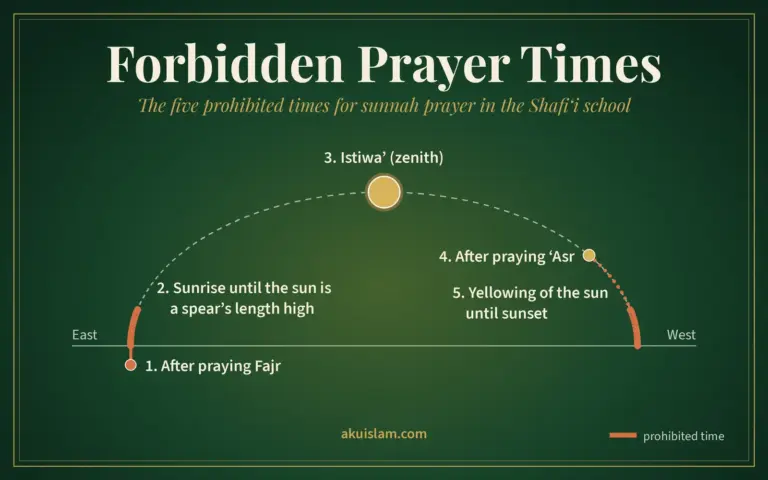
However, nafl mutlaq is not valid if prayed during a prohibited time, because it has no cause that would exempt it.2 The prohibited times are:
- After praying Fajr until the sun rises.
- From sunrise until the sun has risen the height of a spear. Check the Dhuha time in your local prayer timetable.
- When the sun is at its zenith (istiwa’), just before Zuhr time comes in, except on Friday.
- After praying Asr until the sun turns yellow.
- From when the sun turns yellow until it sets.
According to the sound view, this prohibition does not apply in the Sacred Precinct of Makkah.2
Related guide
The five prohibited times, the reason behind them, and the sunnah prayers that are still allowed.
Dua After Nafl Mutlaq
There is no special wording. Ask Allah for what you need.
Nafl mutlaq has no special wording of dua. After the salam, recite the dhikr and duas after prayer as usual, then ask Allah for whatever you need, in Arabic or in your own language.

Full guide
Dhikr and duas after prayer with Arabic, transliteration and audio.
Optional Practice: The Master of Istighfar (Sayyid al-Istighfar)
This section is sunnah, not obligatory. It is a general dua of istighfar that the Prophet ﷺ called the master of istighfar, not a dua specific to nafl mutlaq.34
اللَّهُمَّ أَنْتَ رَبِّي لَا إِلٰهَ إِلَّا أَنْتَ، خَلَقْتَنِي وَأَنَا عَبْدُكَ، وَأَنَا عَلَىٰ عَهْدِكَ وَوَعْدِكَ مَا اسْتَطَعْتُ، أَعُوذُ بِكَ مِنْ شَرِّ مَا صَنَعْتُ، أَبُوءُ لَكَ بِنِعْمَتِكَ عَلَيَّ، وَأَبُوءُ لَكَ بِذَنْبِي فَاغْفِرْ لِي، فَإِنَّهُ لَا يَغْفِرُ الذُّنُوبَ إِلَّا أَنْتَ
Allāhumma anta rabbī, lā ilāha illā anta, khalaqtanī wa ana ‘abduk, wa ana ‘alā ‘ahdika wa wa‘dika mastaṭa‘tu, a‘ūdhu bika min sharri mā ṣana‘tu, abū’u laka bini‘matika ‘alayya, wa abū’u laka bidhanbī, faghfir lī, fa innahu lā yaghfirudh-dhunūba illā anta.
Meaning
“O Allah, You are my Lord. There is no god but You. You created me, and I am Your servant. I hold to Your covenant and Your promise as much as I am able. I seek refuge in You from the evil of what I have done. I acknowledge Your blessing upon me, and I acknowledge my sin, so forgive me. Indeed, none forgives sins except You.”
Virtues of Nafl Prayer
The reward for those who pray many voluntary prayers.
Loved by Allah
In a hadith qudsi, Allah says that His servant keeps drawing near to Him with voluntary deeds until Allah loves him.6
Making Up for Shortcomings in the Obligatory Prayers
On the Day of Reckoning, if a person’s obligatory prayers are lacking, the shortfall is made up with the voluntary prayers he performed.7
Raised in Rank and Sins Removed
“You do not make a single prostration to Allah except that Allah raises you by it one degree and removes from you one sin.”9
A Way to Be With the Prophet ﷺ in Paradise
Rabi‘ah ibn Ka‘b RA asked to be with the Prophet ﷺ in Paradise. He replied: “Then help me for your own sake by making many prostrations.”35
Nafl Mutlaq FAQ
Short answers to questions readers often ask.
To add voluntary deeds and draw near to Allah at any time, without being tied to a particular time or cause. It also makes up for shortcomings in the obligatory prayers.6,7
A sunnah prayer that is not tied to a particular time or cause, with no limit to the number of rak‘ahs.1,3
“Uṣallī sunnatan rak‘ataini lillāhi ta‘ālā”, meaning: I pray two rak‘ahs of a sunnah prayer for the sake of Allah, the Most High. Intending in the heart to perform a prayer at the opening takbir is enough.5
There is no limit. The best is two rak‘ahs with one salam, repeated as you are able.3,4
Yes, it is valid. You may sit for the tashahhud after every two rak‘ahs. However, giving salam after every two rak‘ahs is better.3,4
Any time, day or night, except the prohibited times. The night is best.2,4
No. After praying Fajr and after praying Asr are prohibited times, and nafl mutlaq is not valid then.2
Yes, before the khatib goes up and sits on the pulpit. Friday is also exempt from the prohibition of praying at istiwa’.11,2
Praying two rak‘ahs while waiting for the Friday sermon, in the Rawdah, when facing a difficulty, or at night, without intending a particular sunnah prayer.11,8
Yes. The reward of tahiyyat al-masjid is also gained with any other two-rak‘ah voluntary prayer prayed after entering the mosque.13
Other sunnah prayers have a time, such as Dhuha, or a cause, such as tahiyyat al-masjid, and their name must be stated in the intention. Nafl mutlaq has no particular time or cause.1
There is no special wording. After the dhikr, ask Allah for whatever you need.
Yes, even if you are able to stand.33
Closing
Nafl mutlaq is a door that is always open. There is no particular time to wait for, no cause that must be present, and no fixed number of rak‘ahs.
Start with two rak‘ahs at your most free time, for example before sleeping or while waiting for the Friday sermon. Make it a habit, even if it is small.
May this be of benefit.
Footnotes & References
- A sunnah prayer with a set time or a cause must have its name specified in the intention like an obligatory prayer, while for nafl mutlaq the intention to perform a prayer is enough. This is what distinguishes nafl mutlaq from other sunnah prayers. [al-Nawawi, Minhaj al-Talibin, Chapter on the Description of Prayer: «والنفل ذو الوقت أو السبب كالفرض فيما سبق» … «ويكفي في النفل المطلق نية فعل الصلاة»] ↩︎
- Prayer is prohibited at istiwa’ except on Friday, after Fajr until the sun has risen the height of a spear, and after Asr until sunset, except for a prayer that has a cause. This prohibition does not apply in the Sacred Precinct of Makkah according to the sound view. The prohibition is one of unlawfulness, and such a prayer is not valid. [al-Nawawi, Minhaj al-Talibin, 1/22: «وتكره الصلاة عند الاستواء إلا يوم الجمعة، وبعد الصبح حتى ترتفع الشمس كرمح، والعصر حتى تغرب إلا لسبب» … «وإلا في حرم مكة على الصحيح». Ibn Hajar al-Haytami, Tuhfat al-Muhtaj, 1/440-441: «وهي للتحريم وقيل للتنزيه وعليهما لا تنعقد»] ↩︎
- There is no limit to the number of rak‘ahs of nafl mutlaq. If a person intends more than one rak‘ah, he may sit for the tashahhud after every two rak‘ahs, but not after every rak‘ah according to the sound view. If he intends a particular number, he may add to it or reduce it on condition that he changes his intention first, otherwise his prayer is invalid. If he intends two rak‘ahs and then stands for a third out of forgetfulness, he sits back down, then stands to add if he wishes. [al-Nawawi, Minhaj al-Talibin, Chapter on Voluntary Prayer, 1/36: «ولا حصر للنفل المطلق فإن أحرم بأكثر من ركعة فله التشهد في كل ركعتين وفي كل ركعة. قلت: الصحيح منعه في كل ركعة والله أعلم وإذا نوى عددا فله أن يزيد وينقص بشرط تغيير النية قبلهما وإلا فتبطل. فلو نوى ركعتين ثم قام إلى ثالثة سهوا فالأصح أنه يقعد ثم يقوم للزيادة إن شاء»] ↩︎
- Voluntary prayer at night is better, the middle of the night is better, then the last part of the night, and it is sunnah to give salam after every two rak‘ahs. [al-Nawawi, Minhaj al-Talibin, Chapter on Voluntary Prayer, 1/36: «قلت: نفل الليل أفضل، وأوسطه أفضل، ثم آخره. وأن يسلم من كل ركعتين»] The Prophet ﷺ said: “The night prayer is two rak‘ahs, two rak‘ahs.” [Sahih al-Bukhari, no. 990] ↩︎
- For nafl mutlaq, the intention to perform a prayer is enough. According to the sound view, intending it as “sunnah” is not a condition either. The intention is in the heart, and it is recommended to say it just before the takbir. [al-Nawawi, Minhaj al-Talibin, Chapter on the Description of Prayer: «قلت: الصحيح لا تشترط نية النفلية، والله أعلم. ويكفي في النفل المطلق نية فعل الصلاة، والنية بالقلب ويندب النطق قبيل التكبير»] ↩︎
- Hadith qudsi: “My servant continues to draw near to Me with voluntary deeds until I love him.” [Sahih al-Bukhari, no. 6502: «وما يزال عبدي يتقرب إلي بالنوافل حتى أحبه»] ↩︎
- If a person’s obligatory prayers are found lacking, Allah says: “See whether My servant has any voluntary prayers,” and the shortfall of his obligatory prayers is made up with them. [Sunan Abi Dawud, no. 864] ↩︎
- Hudhayfah RA said: “When something troubled the Prophet ﷺ, he would pray.” [Sunan Abi Dawud, no. 1319: «كان النبي صلى الله عليه وسلم إذا حزبه أمر، صلى»] ↩︎
- The Prophet ﷺ said to Thawban RA: “Make many prostrations to Allah, for you do not make a single prostration to Allah except that Allah raises you by it one degree and removes from you one sin.” [Sahih Muslim, no. 488: «فإنك لا تسجد لله سجدة، إلا رفعك الله بها درجة، وحط عنك بها خطيئة»] ↩︎
- Prayer is the best act of bodily worship after the two testimonies of faith, and voluntary prayer is the best of voluntary deeds. In the order of merit among the sunnah prayers, nafl mutlaq comes last. [Ibn Hajar al-Haytami, Tuhfat al-Muhtaj, 2/220: «وأفضل عبادات البدن بعد الشهادتين الصلاة ففرضها أفضل الفروض ونفلها أفضل النوافل». 2/242: «… فما تعلق بغير سبب منه كسنة الزوال، فالنفل المطلق»] ↩︎
- The Prophet ﷺ said: “Whoever takes a bath, then comes to the Friday prayer, prays what was decreed for him, then remains silent until the imam finishes his sermon, then prays with him, will be forgiven what is between that Friday and the next, plus three days.” [Sahih Muslim, no. 857: «من اغتسل ثم أتى الجمعة، فصلى ما قدر له، ثم أنصت حتى يفرغ من خطبته»] ↩︎
- The Prophet ﷺ said: “What is between my house and my pulpit is one of the gardens of Paradise.” [Sahih al-Bukhari, nos. 1195 and 1196: «ما بين بيتي ومنبري روضة من رياض الجنة»] ↩︎
- Tahiyyat al-masjid is two rak‘ahs, and it is attained with an obligatory prayer or another voluntary prayer, but not with a single rak‘ah. [al-Nawawi, Minhaj al-Talibin, 1/36: «وتحية المسجد ركعتان. وتحصل بفرض أو نفل آخر لا بركعة على الصحيح»] ↩︎
- The Prophet ﷺ said: “The best prayer is a person’s prayer in his home, except the obligatory prayer.” [Sahih al-Bukhari, no. 731] ↩︎
- Once the khatib has sat on the pulpit, it is unlawful for someone already in the mosque to begin a voluntary prayer. Someone who enters during the sermon is recommended to pray two short rak‘ahs of tahiyyat al-masjid. [Ibn Hajar al-Haytami, Tuhfat al-Muhtaj, 2/455-457] [al-Nawawi, Rawdat al-Talibin, 2/30: «ولو دخل في أثناء الخطبة، استحب له أن يصلي التحية، ويخففها»] ↩︎
- The intention is in the heart and must accompany the opening takbir, while saying it aloud before the takbir is recommended so the tongue helps the heart. [Minhaj al-Talibin, Chapter on the Description of Prayer] [Al-Kafi #945] ↩︎
- It is sunnah to raise the hands at the takbir, with the fingertips level with the top of the ears, the thumbs level with the earlobes and the palms level with the shoulders. [Tuhfat al-Muhtaj 2/18] [Sahih al-Bukhari 735] ↩︎
- It is sunnah to place the hands below the chest, with the right hand holding the left wrist. [Minhaj al-Talibin, Chapter on the Description of Prayer] [Sahih Muslim 401] ↩︎
- The opening dua is sunnah and is recited quietly after the opening takbir. The wording common in Malaysia combines two authentic narrations. [Minhaj al-Talibin, Chapter on the Description of Prayer] [Sahih Muslim 601] [Sahih Muslim 771] ↩︎
- After the opening dua, it is sunnah to recite the ta‘awwuz quietly before al-Fatihah in every rak‘ah, and it is more emphasised in the first rak‘ah. [Minhaj al-Talibin, Chapter on the Description of Prayer: «ثم التعوذ ويسرهما ويتعوذ في كل ركعة على المذهب والأولى آكد»] ↩︎
- In the Shafi‘i school, al-Fatihah must be recited in every rak‘ah by the imam, the follower and the one praying alone. [al-Majmu‘ 3/364] ↩︎
- After al-Fatihah, it is sunnah to say “Āmīn” with the letter mim unstressed. [Minhaj al-Talibin, Chapter on the Description of Prayer: «ويسن عقب الفاتحة آمين خفيفة الميم»] ↩︎
- It is sunnah to say the takbir as you begin to bow for ruku‘ and to raise the hands as at the opening takbir. The complete ruku‘ is to keep the back and neck level and hold the knees with the fingers spread. [Minhaj al-Talibin, Chapter on the Description of Prayer: «وأكمله تسوية ظهره وعنقه ونصب ساقيه وأخذ ركبتيه بيديه وتفرقة أصابعه للقبلة ويكبر في ابتداء هويه ويرفع يديه كإحرامه»] ↩︎
- The hadith of Abu Hurairah RA about the man who prayed hastily: the Prophet ﷺ told him to repeat his prayer and taught him to bow, stand, prostrate and sit calmly. [Sahih al-Bukhari 757] [Sahih Muslim 397] The measure of tuma’ninah is that the body settles for a moment so that the movement down is separate from the movement up. [Tuhfat al-Muhtaj 2/59] ↩︎
- It is sunnah to raise the hands as you begin to lift your head from ruku‘ while saying “Sami‘allāhu liman ḥamidah”. [Minhaj al-Talibin, Chapter on the Description of Prayer: «ويسن رفع يديه مع ابتداء رفع رأسه قائلا سمع الله لمن حمده»] ↩︎
- The minimum of sujud is for part of the forehead to touch the place of prostration directly. Placing both hands, both knees and both feet is also obligatory according to the view preferred by al-Nawawi, and the hips must be higher than the head. It is sunnah to say the takbir while going down without raising the hands, and to place the knees, then the hands, then the forehead and nose. The second sujud is made like the first. [Minhaj al-Talibin, Chapter on the Description of Prayer: «وأقله مباشرة بعض جبهته مصلاه… قلت: الأظهر وجوبه… وأن ترتفع أسافله على أعاليه في الأصح وأكمله يكبر لهويه بلا رفع ويضع ركبتيه ثم يديه ثم جبهته وأنفه», «ثم يسجد الثانية كالأولى»] ↩︎
- The complete sitting between the two prostrations is to say the takbir while rising, sit in iftirash and place the hands on the thighs near the knees. [Minhaj al-Talibin, Chapter on the Description of Prayer: «وأكمله يكبر ويجلس مفترشا واضعا يديه قريبا من ركبتيه»] ↩︎
- The hadith of Abu Humayd al-Sa‘idi RA: in the last rak‘ah, the Prophet ﷺ put his left foot forward, kept his right foot upright and sat on his seat. [Sahih al-Bukhari 828] [Minhaj al-Talibin, Chapter on the Description of Prayer] ↩︎
- Imam al-Nawawi states that after the final tashahhud and the salawat, it is sunnah to make dua, and a dua narrated from the Prophet ﷺ (ma’thur) is better. [Minhaj al-Talibin, Chapter on the Description of Prayer] ↩︎
- Sending blessings on the Prophet ﷺ in the final tashahhud is a pillar, and the minimum is “Allāhumma ṣalli ‘alā Muḥammad”. Adding blessings on his family and the Ibrahimi salawat is more complete. [Minhaj al-Talibin, Chapter on the Description of Prayer] [Tuhfat al-Muhtaj 2/86] ↩︎
- The right index finger is raised when saying “illallāh”, is not moved, and stays raised until the end of the tashahhud. [Tuhfat al-Muhtaj 2/80] [Sahih Muslim 580] ↩︎
- The minimum salam is “As-salāmu ‘alaikum”. The most complete is “As-salāmu ‘alaikum wa raḥmatullāh” twice, to the right and then to the left. [Minhaj al-Talibin, Chapter on the Description of Prayer] ↩︎
- A person who is able to stand may pray voluntary prayers sitting. [al-Nawawi, Minhaj al-Talibin, Chapter on the Description of Prayer, 1/25: «وللقادر التنفل قاعدا»] ↩︎
- The Prophet ﷺ named this dua the master of istighfar. Whoever says it with certainty during the day and dies that day before evening is among the people of Paradise. The same applies if it is said at night. [Sahih al-Bukhari, no. 6306] ↩︎
- Rabi‘ah ibn Ka‘b al-Aslami RA asked to be with the Prophet ﷺ in Paradise. He said: “Then help me for your own sake by making many prostrations.” [Sahih Muslim, no. 489: «فأعني على نفسك بكثرة السجود»] ↩︎
Further Reading
- al-Nawawi, Minhaj al-Talibin wa ‘Umdat al-Muftin.
- al-Nawawi, Rawdat al-Talibin, volume 2.
- Ibn Hajar al-Haytami, Tuhfat al-Muhtaj bi Sharh al-Minhaj, volumes 1 and 2.
- al-Bukhari, Sahih al-Bukhari. Muslim, Sahih Muslim. Abu Dawud, Sunan Abi Dawud.