

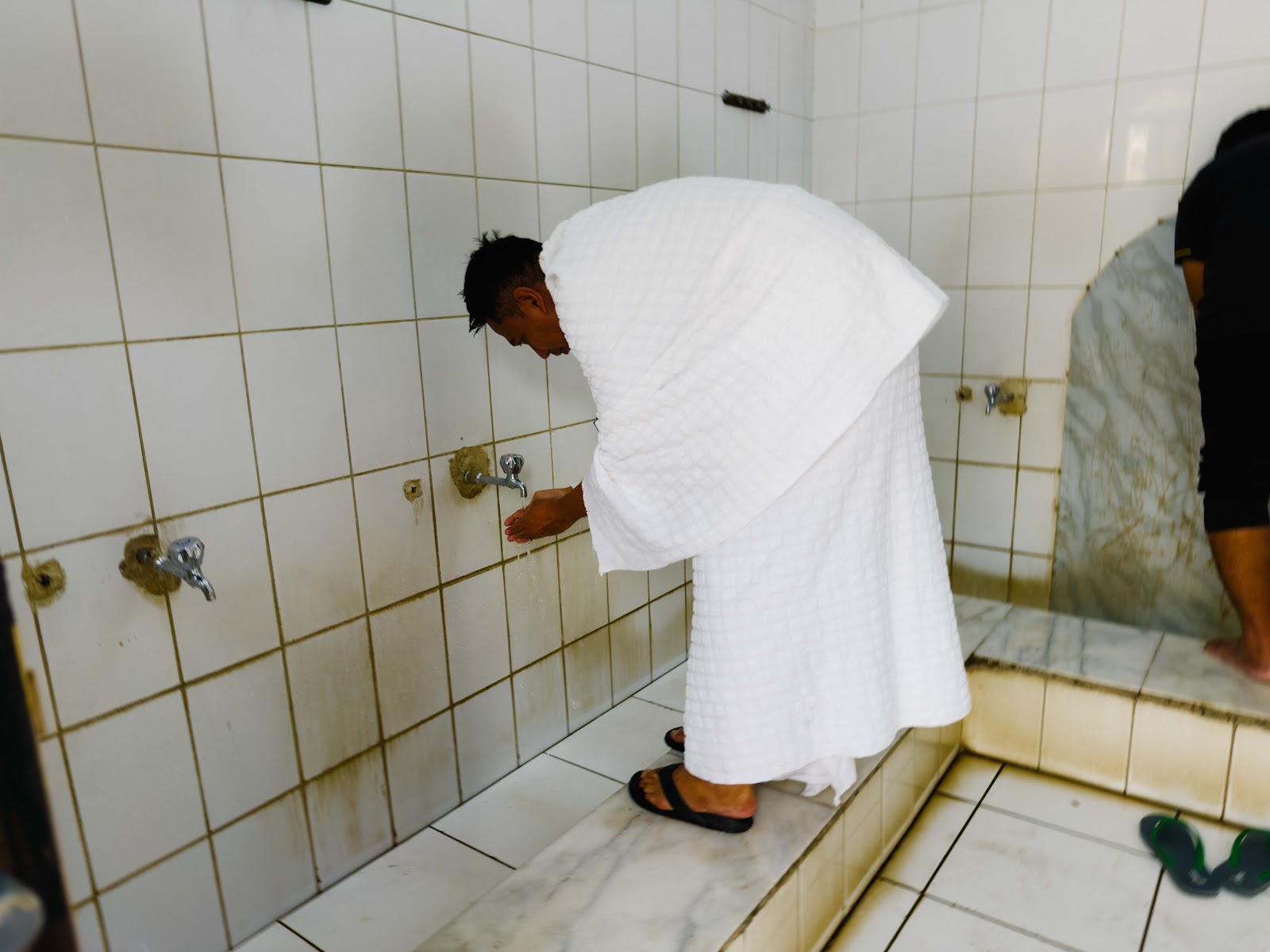
This is a complete guide to the dua after wudu and the niyyah (intention) for wudu, in Arabic, transliteration and meaning, together with how and when to say them according to the Shafi‘i school.
It explains when the intention is made, the wordings you may choose from, the dua after wudu as arranged by Imam al-Nawawi, and its virtue. At the end are the conditions for a valid wudu and answers to common questions.
Dua After Wudu at a Glance
- Intention: Nawaitu raf‘al-ḥadathil-aṣghari lillāhi ta‘ālā, “I intend to lift the minor state of impurity for the sake of Allah the Most High”.
- When to intend: in the heart, as the water first washes the face. Saying it aloud beforehand is sunnah.
- Dua after wudu: Ashhadu allā ilāha illallāhu waḥdahū lā sharīka lah, wa ashhadu anna Muḥammadan ‘abduhū wa rasūluh. Allāhummaj‘alnī minat-tawwābīn, waj‘alnī minal-mutaṭahhirīn …
- Etiquette: face the qiblah, raise your hands and your gaze to the sky, and say it straight after wudu.
- Virtue: the eight gates of Paradise are opened, to enter by whichever one you wish.
Niyyah for Wudu (Arabic, Transliteration and Meaning)
The intention is the first integral of wudu. Without it, wudu is not valid.
The wording of the intention commonly used in Malaysia is:
Niyyah for wudu
نَوَيْتُ رَفْعَ الْحَدَثِ الْأَصْغَرِ لِلّٰهِ تَعَالَى
Nawaitu raf‘al-ḥadathil-aṣghari lillāhi ta‘ālā.
I intend to lift the minor state of impurity for the sake of Allah the Most High.1
The real intention is in the heart: a conscious resolve to lift the minor state of impurity. It must be present as the water first washes the face, not before.2
Saying the intention with the tongue is sunnah. Its purpose is to help the heart bring the intention to mind. So say it before you begin wudu, then hold the intention in your heart as the water touches your face.3
Optional Practice: Other Wordings and the Intention for Continuous Impurity
This section is optional. The wording above is enough.
Besides intending to lift impurity, intending to perform the obligatory wudu is also valid:
Niyyah for wudu (obligatory wudu)
نَوَيْتُ أَدَاءَ فَرْضِ الْوُضُوءِ لِلّٰهِ تَعَالَى
Nawaitu adā’a farḍil-wuḍū’i lillāhi ta‘ālā.
I intend to perform the obligatory wudu for the sake of Allah the Most High.
A person whose state of impurity is continuous, such as a woman with istihadah or someone who cannot hold their urine, cannot intend to lift impurity because it is not lifted. They intend to make prayer permissible:4
Niyyah for wudu (continuous impurity)
نَوَيْتُ اسْتِبَاحَةَ الصَّلَاةِ لِلّٰهِ تَعَالَى
Nawaitu istibāḥataṣ-ṣalāti lillāhi ta‘ālā.
I intend to make prayer permissible for me, for the sake of Allah the Most High.
Dua After Wudu (Arabic, Transliteration and Meaning)
Said straight after completing wudu, facing the qiblah.
Read it from beginning to end as one continuous dua:
Dua after wudu
أَشْهَدُ أَنْ لَا إِلٰهَ إِلَّا اللّٰهُ وَحْدَهُ لَا شَرِيكَ لَهُ، وَأَشْهَدُ أَنَّ مُحَمَّدًا عَبْدُهُ وَرَسُولُهُ، اللّٰهُمَّ اجْعَلْنِي مِنَ التَّوَّابِينَ، وَاجْعَلْنِي مِنَ الْمُتَطَهِّرِينَ، سُبْحَانَكَ اللّٰهُمَّ وَبِحَمْدِكَ، أَشْهَدُ أَنْ لَا إِلٰهَ إِلَّا أَنْتَ، أَسْتَغْفِرُكَ وَأَتُوبُ إِلَيْكَ
Ashhadu allā ilāha illallāhu waḥdahū lā sharīka lah, wa ashhadu anna Muḥammadan ‘abduhū wa rasūluh. Allāhummaj‘alnī minat-tawwābīn, waj‘alnī minal-mutaṭahhirīn. Subḥānakallāhumma wa biḥamdik, ashhadu allā ilāha illā anta, astaghfiruka wa atūbu ilaik.
I bear witness that there is no god but Allah, alone, without partner, and I bear witness that Muhammad is His servant and His messenger. O Allah, make me among those who repent, and make me among those who purify themselves. Glory be to You, O Allah, and with Your praise. I bear witness that there is no god but You. I seek Your forgiveness and I turn to You in repentance.5
The first part of this dua, the two testimonies of faith, is narrated by Muslim. If time is short, the testimony alone already earns the virtue mentioned in the hadith.6
Optional Practice: The Addition “Waj‘alnī min ‘Ibādikaṣ-Ṣāliḥīn”
This section is sunnah, not obligatory.
Many in Malaysia add one line after waj‘alnī minal-mutaṭahhirīn. This addition is mentioned in I‘anat al-Talibin, but it is not in the hadith narrated by Muslim and al-Tirmidhi. It is a good dua and may be said, as long as it is not treated as part of the wording of the hadith.7
Addition to the dua after wudu
وَاجْعَلْنِي مِنْ عِبَادِكَ الصَّالِحِينَ
Waj‘alnī min ‘ibādikaṣ-ṣāliḥīn.
And make me among Your righteous servants.
How to Make the Intention and Say the Dua
Follow these 5 steps, from before wudu until the dua is complete.
Say the Intention Before You Begin (Sunnah)
Before starting wudu, say the intention quietly:
Niyyah for wudu
نَوَيْتُ رَفْعَ الْحَدَثِ الْأَصْغَرِ لِلّٰهِ تَعَالَى
Nawaitu raf‘al-ḥadathil-aṣghari lillāhi ta‘ālā.
I intend to lift the minor state of impurity for the sake of Allah the Most High.
Intend in Your Heart as the Water First Washes Your Face
As the first water touches your face, bring to mind: “I am lifting the minor state of impurity for the sake of Allah.” This is the obligatory intention. If the intention was only said at the start but is absent from the heart when washing the face, it does not count.
Complete Wudu in Order
Continue wudu until you finish washing the feet, following the order of the limbs.
Face the Qiblah and Raise Your Hands
Straight after finishing, face the qiblah, raise both hands and lift your gaze to the sky.8
Say the Dua After Wudu
Say this dua straight away, before a long gap of time passes:
Dua after wudu
أَشْهَدُ أَنْ لَا إِلٰهَ إِلَّا اللّٰهُ وَحْدَهُ لَا شَرِيكَ لَهُ، وَأَشْهَدُ أَنَّ مُحَمَّدًا عَبْدُهُ وَرَسُولُهُ، اللّٰهُمَّ اجْعَلْنِي مِنَ التَّوَّابِينَ، وَاجْعَلْنِي مِنَ الْمُتَطَهِّرِينَ، سُبْحَانَكَ اللّٰهُمَّ وَبِحَمْدِكَ، أَشْهَدُ أَنْ لَا إِلٰهَ إِلَّا أَنْتَ، أَسْتَغْفِرُكَ وَأَتُوبُ إِلَيْكَ
Ashhadu allā ilāha illallāhu waḥdahū lā sharīka lah, wa ashhadu anna Muḥammadan ‘abduhū wa rasūluh. Allāhummaj‘alnī minat-tawwābīn, waj‘alnī minal-mutaṭahhirīn. Subḥānakallāhumma wa biḥamdik, ashhadu allā ilāha illā anta, astaghfiruka wa atūbu ilaik.
I bear witness that there is no god but Allah, alone, without partner, and I bear witness that Muhammad is His servant and His messenger. O Allah, make me among those who repent, and make me among those who purify themselves. Glory be to You, O Allah, and with Your praise. I bear witness that there is no god but You. I seek Your forgiveness and I turn to You in repentance.9
If you wish to add waj‘alnī min ‘ibādikaṣ-ṣāliḥīn, see the Optional Practice in the dua after wudu section.
Optional Practice: Two Rak‘ahs of Tahiyatul Wudu
This section is sunnah, not obligatory.
After the dua, pray two rak‘ahs of tahiyatul wudu. The Prophet ﷺ promised Paradise to whoever performs wudu well, then prays two rak‘ahs turning to Allah with both heart and face.10
The intention and method are in the guide to tahiyatul wudu.
Virtue of the Dua After Wudu
A great reward for a short recitation.
‘Umar RA narrated that the Prophet ﷺ said that whoever performs wudu completely and then says the two testimonies of faith will have the eight gates of Paradise opened for him. He may enter by whichever gate he wishes.6
In the narration of al-Tirmidhi there is the addition Allāhummaj‘alnī minat-tawwābīn, waj‘alnī minal-mutaṭahhirīn.11 Repentance cleanses the inner self, and wudu cleanses the outer. This dua brings the two together.
Conditions for a Valid Wudu
The intention and the dua only mean something if the wudu itself is valid.
Besides the intention and the other integrals, wudu also has conditions. According to Fath al-Mu‘in, there are five:12
- Pure water (ma’ mutlaq), that is, water which is pure and purifying.
- Water flowing over the limb being washed. Merely wiping with a wet hand does not count as washing.
- Nothing on the limb that changes the water, such as turmeric or a dye that dissolves until the water can no longer be called plain water.
- No barrier, such as paint, wax, nail polish, henna that forms a coating, or solid grease. Liquid oil and the colour left by henna are not barriers.13
- The time of prayer has begun, specifically for a person whose state of impurity is continuous.
FAQ: Niyyah and Dua After Wudu
Short answers to common questions.
Nawaitu raf‘al-ḥadathil-aṣghari lillāhi ta‘ālā, “I intend to lift the minor state of impurity for the sake of Allah the Most High”. Saying it is sunnah. What is obligatory is the intention in the heart as the water first washes the face.
No. Saying the intention is sunnah, to help the heart. Your wudu is still valid if you intend in your heart only.3
As the water first washes the first part of the face. An intention made only while washing the hands or rinsing the mouth, and then gone before washing the face, is not enough.2
Yes. The intention is an act of the heart, so the language used when saying it does not affect its validity.
If there was no intention at all while washing the face, the wudu is not valid because the intention is the first obligatory act of wudu. Repeat the wudu with the intention.
They intend to make prayer permissible, for example Nawaitu istibāḥataṣ-ṣalāti lillāhi ta‘ālā, not to lift impurity. Their wudu is also only made after the time of prayer begins, as in the conditions for a valid wudu.4
The two testimonies of faith: Ashhadu allā ilāha illallāhu waḥdahū lā sharīka lah, wa ashhadu anna Muḥammadan ‘abduhū wa rasūluh. It is narrated by Muslim, and its virtue is that the eight gates of Paradise are opened.
It is sunnah to face the qiblah, raise both hands and lift your gaze to the sky when saying it.8
No dua for the limbs of wudu comes from the Prophet ﷺ. Imam al-Nawawi mentions that some jurists recommend them because they come from the early generations, but in the Minhaj he leaves them out as having no basis.14
It is disliked to make dhikr in a place where one relieves oneself. If you make wudu in a bathroom that has a toilet, say this dua straight after you step out.15
Say the testimony of wudu first, then the dua after the adhan, then the rest of the wudu dua for yourself. This is the fatwa of al-Bulqini.16
Yes. Imam al-Nawawi quotes Shaykh Nasr al-Maqdisi, who recommends sending blessings and peace upon the Prophet ﷺ together with the dhikr after wudu.17
Yes. Imam al-Nawawi states that it is sunnah for someone who performs ghusl to say the same dhikr, and he holds that tayammum takes the same ruling because it is a purification like wudu.18
Conclusion
Wudu begins with an intention and ends with a dua. The intention turns the washing into worship, and the dua turns outward cleanliness into a path to a clean heart.
Start with the testimony of faith after every wudu until it becomes a habit. Once it comes easily, complete it with the full dua and two rak‘ahs of tahiyatul wudu.
May this be of benefit.
Footnotes & References
- Examples of the wording given in the commentary on Fath al-Mu‘in: «بأن يقول: نويت أداء فرض الوضوء» and «بأن تقول: نويت رفع الحدث». [I‘anat al-Talibin, 1/48] ↩︎
- The intention is the first obligatory act of wudu, and it must accompany the first washing of the face: «فروضه ستة أحدها: نية رفع حدث أو استباحة مفتقر إلى طهر أو أداء فرض الوضوء» and «ويجب قرنها بأول الوجه». [al-Nawawi, Minhaj al-Talibin, p. 12] ↩︎
- «وسن نطق بمنوي» … «ليساعد اللسان القلب». This ruling applies to every act of worship that requires an intention: «قال ع ش: هنا وفي سائر ما يعتبر فيه النية». What counts is the intention in the heart: «إذ العبرة بما في القلب». [I‘anat al-Talibin, 1/152] ↩︎
- «ومن دام حدثه كمستحاضة كفاه نية الاستباحة دون الرفع على الصحيح». [al-Nawawi, Minhaj al-Talibin, p. 12] ↩︎
- Imam al-Nawawi arranges the dua after wudu as follows: «أشهد أن لا إله إلا الله وحده لا شريك له، وأشهد أن محمدا عبده ورسوله، اللهم اجعلني من التوابين، واجعلني من المتطهرين، سبحانك اللهم وبحمدك، أشهد أن لا إله إلا أنت، أستغفرك وأتوب إليك». The testimony of faith is narrated by Muslim, the addition «التوابين … المتطهرين» by al-Tirmidhi, and «سبحانك اللهم وبحمدك» by al-Nasa’i in ‘Amal al-Yawm wa al-Laylah with a weak chain. [al-Nawawi, al-Adhkar, p. 28] The same arrangement is given in [al-Nawawi, Minhaj al-Talibin, p. 13]. ↩︎
- Hadith of ‘Uqbah ibn ‘Amir RA from ‘Umar RA: «ما منكم من أحد يتوضأ فيبلغ – أو فيسبغ – الوضوء ثم يقول: أشهد أن لا إله إلا الله وأن محمدا عبد الله ورسوله إلا فتحت له أبواب الجنة الثمانية يدخل من أيها شاء». [Sahih Muslim, no. 234] ↩︎
- This addition is mentioned in the commentary on the fatwa of al-Bulqini: «ثم بالدعاء لنفسه أي الذي بعد الوضوء، وهو: اللهم اجعلني من التوابين واجعلني من المتطهرين واجعلني من عبادك الصالحين». [I‘anat al-Talibin, 1/281] It is not in the narrations of Muslim and al-Tirmidhi, and it is not part of Imam al-Nawawi’s arrangement. [al-Nawawi, al-Adhkar, p. 28] ↩︎
- «والشهادتان عقبه أي الوضوء، بحيث لا يطول فاصل عنه عرفا، فيقول مستقبلا للقبلة، رافعا يديه وبصره إلى السماء – ولو أعمى -». [I‘anat al-Talibin, 1/67] Imam al-Nawawi: «قال أصحابنا: ويقول هذه الأذكار مستقبل القبلة، ويكون عقيب الفراغ». [al-Nawawi, al-Adhkar, p. 29] ↩︎
- This dua is said «عقب الوضوء بحيث لا يطول بينهما فاصل عرفا فيما يظهر». [Ibn Hajar al-Haytami, Tuhfat al-Muhtaj, 1/238] ↩︎
- The same hadith: «ما من مسلم يتوضأ فيحسن وضوءه، ثم يقوم فيصلي ركعتين، مقبل عليهما بقلبه ووجهه، إلا وجبت له الجنة». [Sahih Muslim, no. 234] ↩︎
- Narrated by al-Tirmidhi with the addition «اللهم اجعلني من التوابين، واجعلني من المتطهرين». Al-Tirmidhi says: «وهذا حديث في إسناده اضطراب». Imam al-Nawawi still includes this addition in his arrangement of the dua after wudu. [Sunan al-Tirmidhi, no. 55] [al-Nawawi, al-Adhkar, p. 28] ↩︎
- «وشروطه أي الوضوء كشروط الغسل خمسة. أحدها: ماء مطلق». The remaining conditions are water flowing over the limb, nothing on the limb that changes the water, no barrier, and the time of prayer having begun for a person whose state of impurity is continuous. [Fath al-Mu‘in with I‘anat al-Talibin, 1/36 to 1/46] ↩︎
- Barriers include «ودهن جامد وعين حبر وحناء، بخلاف دهن جار أي مائع – وإن لم يثبت الماء عليه – وأثر حبر وحناء». [I‘anat al-Talibin, 1/45] ↩︎
- «وأما الدعاء على أعضاء الوضوء، فلم يجئ فيه شئ عن النبي صلى الله عليه وسلم». Imam al-Nawawi then mentions that some jurists recommend these duas because they come from the early generations. [al-Nawawi, al-Adhkar, p. 29] In the Minhaj he leaves them out: «وحذفت دعاء الأعضاء إذ لا أصل له». [al-Nawawi, Minhaj al-Talibin, p. 13] ↩︎
- The scholars state «كراهة الذكر والقراءة في محل قضاء الحاجة». [I‘anat al-Talibin, 2/284] ↩︎
- Fatwa of al-Bulqini: «فيمن وافق فراغه من الوضوء فراغ المؤذن، بأنه يأتي بذكر الوضوء لانه للعبادة التي فرغ منها، ثم بذكر الاذان». «وحسن أن يأتي بشهادتي الوضوء ثم بدعاء الاذان لتعلقه بالنبي (ص)، ثم بالدعاء لنفسه». [I‘anat al-Talibin, 1/281] ↩︎
- «قال الشيخ نصر المقدسي: ويقول مع هذه الأذكار: اللهم صل على محمد وعلى آل محمد، ويضم إليه: وسلم». [al-Nawawi, al-Adhkar, p. 29] ↩︎
- Ghusl: «يستحب للمغتسل أن يقول جميع ما ذكرناه في المتوضئ من التسمية وغيرها». [al-Nawawi, al-Adhkar, p. 29] Tayammum: «والظاهر أن حكمه على ما ذكرنا في الوضوء، فإن التيمم طهارة كالوضوء». [al-Nawawi, al-Adhkar, p. 30] ↩︎
Further Reading
- al-Nawawi, al-Adhkar.
- al-Nawawi, Minhaj al-Talibin wa ‘Umdat al-Muftin.
- al-Bakri al-Dimyati, I‘anat al-Talibin ‘ala Hall Alfaz Fath al-Mu‘in.
- Ibn Hajar al-Haytami, Tuhfat al-Muhtaj bi Sharh al-Minhaj.
- Muslim, Sahih Muslim. al-Tirmidhi, Sunan al-Tirmidhi.